
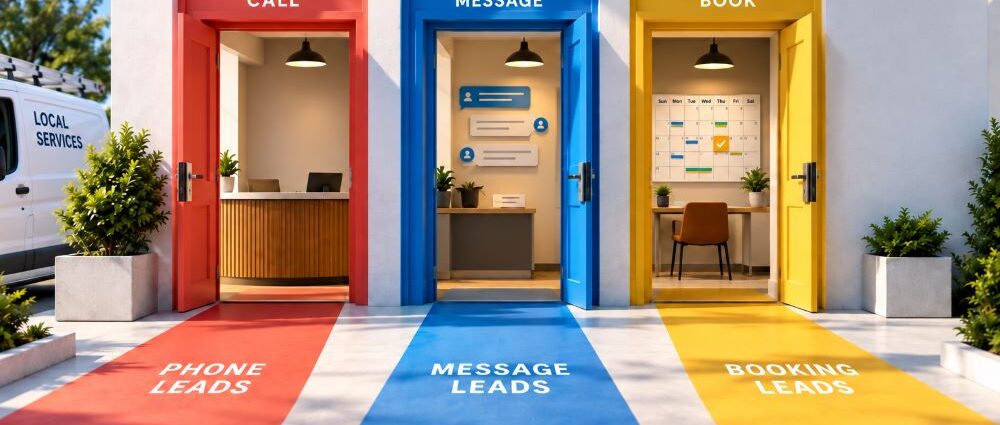
A phone call demands an immediate answer, a message creates a follow-up task, and a direct booking puts an appointment on the calendar before staff may have spoken to the customer. All three can begin with the same Local Services ad, but they create very different work for the business receiving them.
Treating these Local Services Ads lead types as one combined total can hide where revenue is actually won or lost. A business that answers every call in seconds but checks messages twice a day has very different economics from one built around online scheduling, even if both report a similar cost per lead.
How the Three Local Services Ads Lead Types Differ
Phone, message and booking leads start from the same advertising product, but the customer reaches the business in three different ways. That changes response speed, qualification work and how far the prospect has already moved toward an appointment.
| Lead Type | What the Customer Does | Response Need | Main Advantage | Main Risk |
|---|---|---|---|---|
| Phone | Calls the business | Immediate | Real-time qualification and scheduling | Missed or poorly handled calls |
| Message | Sends a written inquiry | Fast follow-up | Lower-friction contact and typically lower lead cost | Slow response or long qualification exchange |
| Booking | Schedules through the ad | Confirm and fulfill | Shorter path to an appointment | Cancellation or poor-fit booking |
Message leads typically cost less than phone leads, while message and booking options give customers another route when nobody can answer immediately. Google’s Local Services lead management guidance covers how businesses receive and handle these interactions.
Phone Leads Reward Immediate Availability
Local Services Ads phone leads compress the distance between search and conversation. Someone searching for an emergency plumber, HVAC repair company or electrician may want an answer now rather than another form to complete.
That urgency can make a phone lead particularly valuable for businesses that have someone ready to answer, qualify the problem and schedule the work. The same lead becomes much less attractive when callers regularly reach voicemail or wait long enough to contact the next provider.
A Missed Call Can Become an Expensive Operational Problem
Advertising teams often treat missed calls as a campaign issue because the money came from the advertising budget. In practice, the problem may sit entirely outside campaign targeting.
If the search was relevant, the customer was inside the service area and the phone rang, the ad already did much of its job. A missed call can turn a valid paid lead into zero revenue even when nothing was wrong with targeting or the Local Services profile.
Phone-lead economics should therefore include call handling. Answer rate, time to answer, qualification and booking rate can tell a local business more than simply comparing the price of its calls with the price of its messages.
Message Leads Trade Urgency for Flexibility
Local Services Ads message leads give customers a lower-pressure way to contact a provider. They can describe a problem while at work, send an inquiry outside office hours or ask about a service or location without starting a phone conversation.
The lower entry cost can make messaging attractive, especially for businesses receiving a high volume of relatively simple inquiries. The economics change quickly, though, when each conversation requires several exchanges before anyone knows whether the prospect is worth pursuing.
The channel works best when someone actually owns the inbox. A business that enables messaging but responds hours later may save money at the first conversion and lose much more during follow-up.
Response Time Can Become Visible to the Customer
Google can display an estimated messaging response time after a business receives at least two message leads within the previous 90 days. Recent replies carry more weight in that estimate, so current response habits matter.
The estimate can become part of what a prospective customer sees before choosing a provider. Consistently fast responses can also help the business compete for visibility and future leads.
A fast first reply can be simple: acknowledge the inquiry, check whether the service and geography fit, then move a viable prospect toward a call or appointment. The goal is to keep a useful conversation moving before the customer contacts another provider.
Message performance deserves its own baseline. Combining message and phone leads into one response metric can make a healthy channel conceal a poorly handled one.
Booking Leads Remove a Step From the Scheduling Process
Local Services Ads booking leads move the customer further into the scheduling workflow before a live conversation has to happen. Instead of contacting the business first and arranging an appointment afterward, an eligible customer can select an available service and time through the booking experience.
Google’s booking lead documentation describes how supported integrations bring appointments into the Local Services workflow. The business still needs accurate availability and a process for confirmations, rescheduling and cancellations after the booking arrives.
For a business with a well-maintained calendar, direct booking can shorten the route from search to appointment. It can also capture demand when nobody is available to answer a phone call.
A Booking Is Still Not a Completed Job
The word “booking” makes this lead type sound close to revenue, and it usually sits further down the funnel than an unanswered message. It still should not be treated as a completed sale.
The customer can cancel, reschedule or fail to appear. The job may also fall outside the practical service area, require work the company does not perform, or produce far less revenue than another appointment occupying the same amount of technician time.
A calendar entry is where booking measurement starts, not where it ends. Cancellation rate, completed-job rate and job value reveal whether direct booking is filling the schedule with real business or simply filling slots.
Does One LSA Lead Type Signal Stronger Intent?
Phone leads often signal urgency because the customer has chosen synchronous contact. Booking leads can show stronger commitment to a specific appointment, while messages may begin with a lighter question that still develops into a valuable job.
Those patterns make broad assumptions tempting, but intent depends heavily on the service. A late-night plumbing caller and someone booking a routine cleaning are both strong prospects in different ways, while a detailed message about an expensive project can be more valuable than either.
Intent is better read from what the customer is trying to accomplish than from the contact button they clicked. Service urgency, job type and the amount of commitment required can change the meaning of each lead type.
Lead Cost and Lead Value Can Point in Opposite Directions
Imagine that a business receives 20 phone leads at $60 each and 30 message leads at $40 each. Both channels cost $1,200, so messaging initially looks stronger because it generated 50% more leads from the same spend.
Now suppose 12 of the phone leads become qualified prospects and eight become booked jobs, while only nine message leads qualify and four book. Cost per lead still favors messaging, but cost per booked job changes to $150 for phone leads and $300 for messages.
Those numbers are illustrative, but the reversal is entirely plausible. A lower CPL can coexist with a much higher cost per booked job when qualification deteriorates.
Tracking lead quality from Google Ads closes the gap between the advertising report and the actual sales outcome. Advertising data explains how the inquiry arrived, while qualification and operational data show whether buying that inquiry made economic sense.
What the 2026 LSA Migration Changes for Lead Handling
Local Services Ads are moving into Google Ads during 2026 as specialized Performance Max campaigns built around pay-per-lead goals. The interface is becoming more unified, but the work behind each lead remains separate.
A ringing phone needs an immediate answer, a message needs follow-up, and a booking needs confirmation and successful fulfillment. Moving those interactions into the same campaign environment does not make their operational demands interchangeable.
For advertisers affected by the Local Services Ads migration in 2026, that distinction matters. Campaigns may sit closer together inside Google Ads, but missed calls, unanswered messages and failed appointments remain three different kinds of lost opportunity.
Measure Each Lead Type Past the Initial Contact
Google’s lead record is only the first row in the business’s own funnel. Phone, message and booking leads should then move through the same internal stages: qualification, appointment, completed job and revenue.
| Stage | Phone Lead | Message Lead | Booking Lead |
|---|---|---|---|
| Initial contact | Call placed | Message sent | Appointment booked |
| Qualified prospect | Track internally | Track internally | Track internally |
| Appointment | Schedule after call | Schedule after exchange | Confirm or reschedule |
| Completed job | Track internally | Track internally | Track internally |
| Revenue / job value | CRM or dispatch data | CRM or dispatch data | CRM or dispatch data |
Direct bookings deserve special scrutiny because the calendar entry can look like success before any work takes place. A high cancellation or no-show rate can erase much of the convenience gained at the front of the funnel.
Phone calls fail differently. A ten-minute conversation may look promising in the lead inbox but produce nothing if the caller sits outside the service area or needs work the company does not offer.
Which Lead Types Should a Local Business Enable?
The practical test is simple: can the business handle each contact method well enough to justify turning it on? Offering more ways to get in touch helps only when staff, scheduling and follow-up can support them.
The decision becomes easier when the company looks at its actual operating limits rather than the number of contact options available. Several questions quickly expose where a lead type fits or creates friction:
- whether someone can answer calls during advertised hours;
- how quickly staff can respond to incoming messages;
- whether the business uses an accurate booking calendar;
- how often appointments need manual qualification before scheduling;
- whether emergency and planned services should follow different contact paths;
- which lead type produces the strongest qualified and completed-job rate.
Plumbing makes the trade-off easy to see. A burst pipe may justify an immediate phone call, while a planned water-heater replacement gives the customer more room to message or schedule ahead.
That distinction is one reason the economics discussed in PPC for plumbers extend beyond the price Google assigns to the initial lead. The contact method tells the business how the conversation started, not how profitable the customer will become.
Enabling every available method is not automatically the best configuration. A contact option that a business handles poorly can introduce another place for strong prospects to disappear.
The Best Lead Mix Depends on What Happens After Contact
A business that answers calls immediately may get more value from phone leads than a competitor with a cheaper message CPL. Another company with disciplined scheduling may find that direct bookings remove enough friction to justify a very different mix.
The useful comparison does not end at Google’s lead charge. Follow each contact through qualification, scheduling, completed work and revenue, and the strongest Local Services Ads lead type usually becomes much easier to identify.