
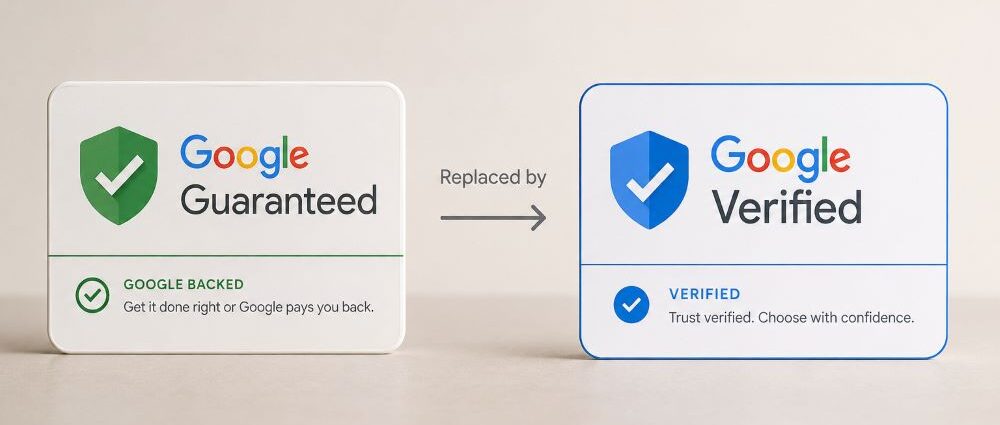
Google Verified is now the main verification badge for eligible businesses in Local Services Ads. It replaced Google Guaranteed, Google Screened, and License Verified by Google as Google moved away from several separate trust labels.
The transition took effect on October 20, 2025. Businesses that had already completed the required checks generally moved to the new badge automatically. Customers saw a more meaningful change: the Money Back Guarantee associated with Google Guarantee was discontinued rather than transferred to Google Verified.
So the new badge should be read quite literally. It shows that a business completed the verification requirements that apply to its category, but it no longer carries the reimbursement element that made the word Guaranteed distinctive.
Google explains the current system in its Google Verified guidance.
Google Verified Replaced More Than Google Guaranteed
Before October 2025, Local Services Ads used several badges. The label a customer saw depended partly on the type of business and the checks required in that market.
The newer system brings those signals under one name.
| Before October 20, 2025 | Current system |
|---|---|
| Google Guaranteed | Google Verified |
| Google Screened | Google Verified |
| License Verified by Google | Google Verified |
| Several verification labels | One primary verification badge |
| Money Back Guarantee associated with Google Guarantee | Discontinued |
This is why older Local Services material can now be confusing. A plumbing agency page that still mentions Google Guaranteed or an old screenshot showing Google Screened may simply predate the change rather than describe a different advertising product.
What matters more than the badge design is what customers can reasonably expect from it.
What Google Guaranteed Actually Meant
Google Guaranteed became especially familiar in home services, where plumbers, HVAC contractors, electricians, cleaners, and similar businesses used Local Services Ads to generate calls and bookings.
To qualify, an advertiser had to complete the screening required for its category and market. Depending on the business, that process could involve licensing, insurance, business registration, identity verification, background screening, or other checks. There was never one identical checklist for every advertiser.
The old badge also had a consumer-protection component.
Customers who booked qualifying services through Local Services Ads could, under certain conditions, request reimbursement when there was a problem with the service. The program had rules, limits, and eligibility requirements, but it gave Google Guaranteed a stronger meaning than a simple verification mark.
That consumer protection did not become part of Google Verified.
What the Google Verified Badge Means Now
Google Verified indicates that an advertiser has completed the checks required for that particular Local Services category.
Those checks still vary. A regulated contractor may need to provide licensing information and insurance, while another business could face identity, registration, background, or other verification requirements. Provider profiles may also show details about checks that have been completed.
The badge is therefore useful, but its scope is narrower than some customers may assume.
Google Verified means that the business passed the applicable Google verification process. It does not mean Google guarantees the quality or outcome of every future job.
A Google Verified plumber has passed the applicable Google screening process. That alone does not tell a homeowner whether the company offers the best price, will arrive fastest, communicates well, or will do the best work.
Recent reviews, service details, availability, pricing, and direct communication still matter. The badge gives the customer another piece of information rather than making the hiring decision for them.
The Old Money Back Guarantee Did Not Move to Google Verified
For people comparing Google Verified with Google Guaranteed, this is the difference most worth knowing.
The old reimbursement program ended.
Customers could previously seek reimbursement for certain qualifying service problems when the booking and claim met Google’s program rules. Transitional arrangements applied to eligible bookings made before the old program closed, but Google Verified itself does not include that benefit.
| Question | Google Guaranteed | Google Verified |
|---|---|---|
| Applicable Google screening completed | Yes | Yes |
| Used with Local Services Ads | Yes | Yes |
| Verification details may be displayed | Yes | Yes |
| Consumer reimbursement program | Yes, subject to conditions | No |
| Unified verification badge | No | Yes |
For an advertiser, the screening side of the system remains important. For a customer, however, the change removes a protection that was closely associated with the old badge.
That is also why describing Google Verified as nothing more than “the new name for Google Guaranteed” leaves out an important part of the story.
Existing Advertisers Usually Do Not Need to Reapply
A business that had already completed its applicable verification generally did not have to start again when Google introduced the new badge. Eligible advertisers were moved to Google Verified as part of the transition.
There is still some routine maintenance involved.
Licenses and insurance can expire. Business names, addresses, and contact information change. Verification requests can also appear later as Google updates its requirements or asks an advertiser to confirm information again.
Existing advertisers should occasionally check that the badge appears correctly, required documents remain current, business details are accurate, and no verification requests are waiting in the account.
That is ordinary account maintenance rather than a special reapplication caused by the 2025 badge change.
How a New Business Gets Google Verified
New Local Services advertisers need to complete the verification process that applies to their category and location.
Google does not use one universal checklist. Its screening and verification process can involve professional or business licenses, insurance, registration, identity checks, background screening, review requirements, or additional checks for particular industries.
A plumber in one state may therefore face a different onboarding process from an attorney, cleaner, moving company, or contractor somewhere else.
This variation is worth remembering when reading broad claims about the badge. Saying that every Google Verified provider goes through exactly the same background check, for example, would be inaccurate.
The requirements shown in the advertiser’s own verification workflow are much more useful than a generic checklist copied from another industry.
Some Businesses Can Advertise Before Getting the Badge
Full verification is not always required before an advertiser can begin receiving Local Services leads.
For some categories, Google allows a pre-badge stage. A business that completes enough of the preliminary onboarding requirements may begin advertising while the rest of its verification is still in progress.
There is a trade-off. These advertisers do not yet display Google Verified, and their listings can appear below businesses that have completed the full onboarding process. Pre-badge advertising is also unavailable in some categories.
For a new business, that makes the distinction fairly practical. The campaign may technically be live while verification is still unfinished.
Completing the remaining checks can therefore matter even when the first leads have already started arriving.
Does Google Verified Improve Local Services Ads Rankings?
Existing advertisers did not receive a fresh ranking advantage simply because Google replaced their old badge with Google Verified.
The pre-badge situation is different.
A provider that is still working through onboarding can appear below businesses that have already completed the full process. That can make full verification relevant to visibility, but it is not the same thing as saying the Google Verified badge introduced a new ranking boost.
The distinction is useful because discussions about Local Services rankings often mix the two ideas together.
An established business changing from Google Guaranteed to Google Verified is going through a branding and verification-system transition. A new advertiser still waiting to qualify for the badge is at a different stage of the Local Services program.
Where Can the Google Verified Badge Appear?
Customers will most obviously see Google Verified on a Local Services business profile. Google can also use verification information elsewhere when it believes that information can help someone evaluate a provider.
Using one label across the system makes the trust signal easier to recognize than the old collection of badges.
Still, a badge has limits. A verified provider with weak reviews, inaccurate hours, unanswered calls, or unclear service information can easily lose a customer to another business.
For local service companies, maintaining the information around the badge is at least as important as displaying the badge itself.
What Customers Should Understand About Google Verified
A customer can reasonably take Google Verified as evidence that Google carried out the applicable screening for that advertiser.
There are several things the badge does not establish:
- Google does not employ the provider;
- it does not inspect every completed job;
- it does not promise a particular standard of service;
- it does not automatically provide a refund if the customer is unhappy;
- it does not identify the cheapest provider;
- it does not mean the company is Google’s top-ranked local business.
For a straightforward service call, reviews, availability, communication, and pricing may provide enough additional context. Larger or regulated jobs can justify checking licenses or insurance directly as well.
Google Verified reduces some uncertainty at the beginning of the decision. Customers still have to evaluate the provider they are hiring.
Google Verified Is Part of a Bigger Local Services Change
The badge transition has happened during a broader reshaping of Local Services Ads.
In 2026, Google began moving selected Local Services campaigns into Google Ads. Budgets, bidding, historical reporting, and lead management are among the areas affected by that shift, with the operational changes outlined in the Local Services Ads migration guide.
The two developments solve different problems. Google Verified standardizes how screening is presented to customers, while the migration changes where and how advertisers manage Local Services campaigns.
For businesses running Search Ads alongside LSA, the distinction is useful. More of the advertising workflow is moving into Google Ads, while verification continues to determine whether and how the local provider can participate in the Local Services ecosystem.
Google Verified Is a Verification Badge, Not a Guarantee
For established advertisers, the switch to Google Verified was mostly uneventful. Businesses that had already met the applicable requirements generally received the new badge without repeating the whole process.
Customers have more reason to notice the distinction.
The badge still says something useful: Google has checked the provider according to the requirements that apply to that business. What it no longer carries is the reimbursement program associated with the old Google Guarantee.
That context matters whenever an older article or company website still advertises a business as Google Guaranteed. The terminology may simply be outdated, but the difference between the old and current programs is real.
Google Verified can help establish initial trust. Reviews, service details, responsiveness, pricing, and the quality of the actual provider still determine what happens after that.