
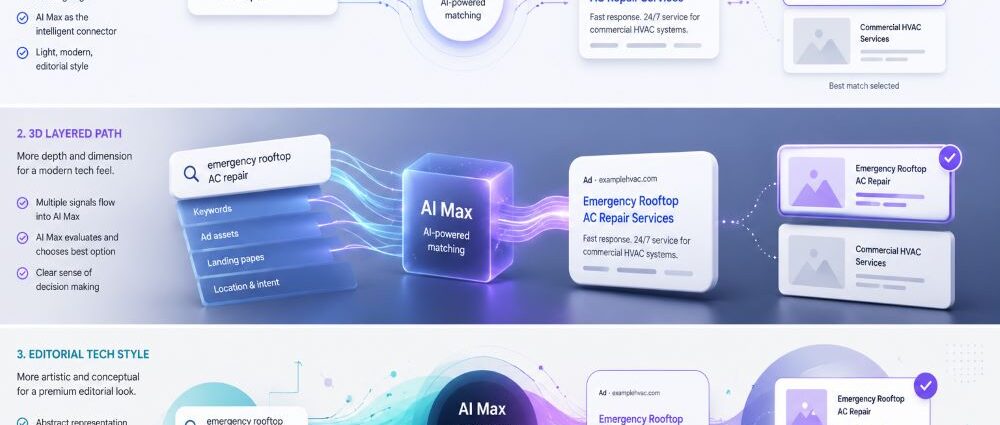
AI Max for Search campaigns adds more automation to an existing Search campaign. Google can use a wider set of signals to reach relevant searches, create additional ad text, and send a click to another page when that page appears to match the query better.
AI Max runs inside the Search campaign that is already in the account. Ad groups, keywords, negative keywords, bidding, and Search reporting remain part of the setup. Google simply has more information available when deciding whether to enter an auction and which combination of message and landing page to use.
That has become more relevant in 2026 as several older Search features begin moving under the AI Max framework.
Google’s main AI Max for Search campaigns documentation explains the individual settings. For advertisers, the more practical issue is how those settings behave once they are used together.
How AI Max Fits Into Search Campaigns
AI Max and Performance Max have similar names, but they occupy different places in Google Ads.
AI Max extends an existing Search campaign. Performance Max is its own campaign type and can distribute ads across several Google properties.
| AI Max for Search | Performance Max |
|---|---|
| Works inside an existing Search campaign | Separate campaign type |
| Focused on Search inventory | Can serve across multiple Google properties |
| Search structure remains in place | Uses its own campaign structure |
| Keywords can remain | Not primarily organized around keywords |
| Search-term controls and reporting remain important | Broader cross-channel automation |
| Expands matching, creative, and landing-page selection | Automates targeting and delivery across channels |
Both can run in the same account. Search remains the campaign environment for AI Max, with the additional automation working inside it.
This is worth establishing early because otherwise features such as keywordless matching and Final URL expansion can make AI Max sound closer to Performance Max than it really is.
What AI Max Actually Changes
Three features account for most of the practical difference: search term matching, text customization, and Final URL expansion.
Search Term Matching
Keywords still contribute to matching, but Google can also look at ads, assets, and landing pages when deciding whether a search is relevant.
Search term matching combines broad-match technology with those additional campaign signals. A user’s wording can therefore qualify even when it does not correspond neatly to an exact, phrase, or broad keyword already present in the account.
Consider a commercial HVAC campaign containing keywords around commercial HVAC repair and rooftop AC service. The advertiser also has a page dedicated to emergency commercial repairs. A query such as emergency rooftop air conditioner repair gives Google several signals to work with at once: the keyword theme, the ad copy, and the content of that specialized page.
Keywords remain part of the campaign, although they are no longer Google’s only source for interpreting search intent.
For an account built heavily around exact and phrase match, that can open new search territory. A campaign already making extensive use of broad match may see less additional reach.
Text Customization
Text customization is the newer name for automatically created assets.
Google can produce additional headlines and descriptions from material already available in the campaign and on the advertiser’s site. Existing RSA assets can continue serving alongside those generated additions.
For advertisers, the main concern is whether generated wording stays within the language the business is willing or allowed to use.
A headline can be factually accurate while still conflicting with an internal brand rule, an approved offer, or wording required in a regulated industry. Franchises and businesses with tightly controlled claims have more reason to review these assets closely than an advertiser with flexible messaging.
Asset reporting gives the account manager a way to see what Google added rather than leaving generated copy hidden from view.
Final URL Expansion
Final URL expansion changes where a click can land.
Suppose an RSA normally points to:
/hvac/A user searches:
emergency rooftop ac repairand the same site contains:
/commercial-hvac/emergency-repair/Google may choose the second page when it considers that destination a closer match for the query.
On a well-organized site, this can save advertisers from manually mapping every possible search theme to a specialized service, product, or location page.
Large sites also contain plenty of URLs that were never intended for paid acquisition, which is where the feature needs closer supervision.
Final URL Expansion Needs More Attention Than It Gets
Search advertisers have traditionally chosen the destination while building an ad. Final URL expansion makes that relationship more flexible.
Pinned RSA assets can also be affected. When Google selects a different page, a pinned headline or description may be left out if the system considers it unsuitable for the new destination.
A local contractor with loose messaging rules may never run into a serious problem. The situation changes for a financial advertiser, healthcare provider, franchise, or business where particular wording has to appear.
The website itself should also be reviewed before broader URL selection is allowed. Possible exclusions include:
- careers and recruitment pages;
- login or customer account areas;
- expired promotions;
- discontinued products or services;
- support documentation;
- low-intent blog posts;
- old location pages;
- pages containing obsolete prices or claims.
SEO suitability and paid-traffic suitability are different standards. A useful informational page can rank well organically and still make little sense as the destination for a costly Search click.
Tracking deserves a check at the same time. Custom parameters, ValueTrack settings, redirects, and third-party tracking templates built around fixed URLs may behave differently when destinations change dynamically.
Testing several expanded URLs before relying on them at scale is much easier than diagnosing broken attribution after traffic has already been sent.
Advertisers Still Have Controls
AI Max widens Google’s room to make decisions, while familiar restrictions still shape where that automation can go.
Negative keywords remain relevant. Advertisers can use brand settings, geographic controls, and URL rules to narrow the areas where Google expands.
Location intent is particularly useful when a searcher’s physical location differs from the location mentioned in the query.
Someone sitting in New York could search for:
divorce lawyer in Miamior:
warehouse storage in DallasIn those cases, the geographic meaning expressed by the search can be more valuable than the user’s current physical location.
URL rules handle another common problem. A large domain might contain hundreds or thousands of pages, but only a subset belongs in the paid-acquisition path.
As Google takes over more of the query-to-message-to-page connection, the quality of those boundaries matters more. Weak exclusions or outdated site content can give the system reasonable-looking options that make little commercial sense.
AI Max Reporting Goes Beyond a Campaign-Level CPA
A campaign-level CPA is useful, but it cannot explain what AI Max changed underneath the total.
Google has added reporting that helps advertisers trace expanded activity through search terms, matching sources, generated assets, and selected landing pages.
That makes it possible to review questions such as:
- Which new searches appeared?
- Where did Google send those users?
- Which headline served?
- Did the traffic convert?
- Were those conversions useful to the business?
An account may gain conversion volume overall while still uncovering a weak group of queries or destinations. Those areas can then be restricted without undoing every part of the expansion.
Early monitoring is worthwhile, especially for obvious problems such as broken pages, irrelevant searches, or incorrect messaging. Routine optimization needs a larger sample. Rebuilding the campaign around a few unusual searches can remove traffic that might have performed well once enough data accumulated.
Lead-generation accounts have another complication: Google can only optimize against the conversion signals it receives. If qualified opportunities and junk submissions are recorded as the same conversion, campaign automation receives a distorted picture of success.
September 2026 Changes the Role of AI Max
September 2026 is an important stage in Google’s rollout.
Search campaigns using certain older features are scheduled to move into the AI Max framework, including campaigns with text customization and the campaign-level broad match setting.
The upgrade is limited to the relevant functionality; it is not a blanket activation of every AI Max setting on every Search campaign.
For advertisers already using those older features, AI Max increasingly becomes the place where the controls and reporting are organized rather than an entirely new decision to make.
This transition also gives long-running accounts a reason to inspect older settings. A Search campaign that has been edited for years may still contain exclusions, tracking rules, URLs, or legacy configuration choices that nobody has reviewed recently.
Dynamic Search Ads Are Moving Later
Dynamic Search Ads have obvious overlap with AI Max because website content can influence matching and landing-page selection in both systems.
Their automatic transition follows a later schedule.
Google moved the DSA upgrade to February 2027, leaving existing DSA campaigns outside the September 2026 automatic transition.
That gives advertisers additional time to compare the approaches.
DSA has traditionally relied on website content to identify relevant searches and destinations. AI Max combines website signals with a wider matching system, generated text, newer controls, and more detailed reporting.
Businesses that still use DSA heavily can use the remaining months of 2026 to audit those campaigns and decide how much of the existing structure will still be useful when the transition arrives.
AI Brief Gives Advertisers a New Way to Steer AI Max
AI Brief is one of the more interesting additions announced for 2026.
Instead of expressing every preference through separate settings, advertisers can give AI Max written guidance about areas such as messaging, matching, and audience direction.
A business could describe wording it wants avoided, search themes it wants prioritized, or the kind of audience a campaign is intended to reach. Google can show example outputs before those instructions are applied.
The feature is part of Google’s 2026 AI Max update. Availability can still vary by language, account, and rollout stage, so interfaces may not look identical for every advertiser.
AI Brief also shows how Search campaign management is changing. Some decisions that once required long keyword lists or repeated manual asset edits can increasingly be expressed as instructions and boundaries that Google’s systems interpret.
AI Max vs Broad Match and Performance Max
Broad match overlaps with one part of AI Max: expanding the relationship between a keyword and a search.
AI Max goes further by using other campaign and website signals and by automating parts of the creative and landing-page selection process.
| Broad Match | AI Max |
|---|---|
| Expands matching around keywords | Can use keywords, assets, and landing pages |
| Keyword remains the main starting signal | Can use keywordless matching |
| Does not select another landing page by itself | Final URL expansion can |
| Primarily a matching decision | Combines matching, creative, and destination automation |
Performance Max sits further away from both. It operates as a separate multi-channel campaign rather than extending Search.
For a business that wants to widen Search coverage while retaining Search-specific reporting and controls, AI Max fits that job more closely. A business trying to automate delivery across several Google channels is looking at a different use case.
What Google’s 14% Performance Claim Actually Means
When Google introduced AI Max, it reported that advertisers activating the feature typically saw 14% more conversions or conversion value at a similar CPA or ROAS.
The company reported a larger typical increase among non-retail campaigns where most previous conversion activity came from exact and phrase match keywords.
Those numbers give advertisers a benchmark, but account conditions can produce very different results.
Exact- and phrase-heavy campaigns start from a narrower matching base, so additional automation has more unused search territory available. An account already running broad match extensively may see a smaller change.
Results also depend on conversion measurement, budget, landing pages, and the quality of the actions being fed back into bidding.
If weak leads are recorded as successful conversions, more capable automation may simply find additional users who produce the same weak outcome.
Which Accounts Should Test AI Max First?
The clearest tests usually come from campaigns where measurement and bidding are already stable.
A useful candidate has reliable conversion tracking, enough conversion activity for automated bidding, a website with clearly separated products or services, and enough budget to capture additional relevant searches.
Extra caution makes sense when:
- many pages on the domain are unsuitable for paid traffic;
- ad copy must follow strict legal or brand wording;
- conversion tracking is incomplete;
- offline lead quality is unavailable;
- very different types of leads are assigned the same value.
Existing Search campaigns can also use AI Max experiments instead of relying on a before-and-after comparison across unrelated months.
That matters because a campaign running without AI Max in one season and with it in another may also face different competition, promotions, budgets, or search demand.
For lead-generation campaigns, the comparison is stronger when it includes qualified leads, booked appointments, sales acceptance, or revenue rather than stopping at raw conversion totals.
The same considerations apply when an account is handled through an AdWords management company or managed internally. AI Max adds search expansion, generated messaging, and automated destination choices to the areas someone needs to review.
What Advertisers Still Need to Manage With AI Max
AI Max moves Search further away from manually mapping every keyword to a specific ad and landing page.
Advertisers increasingly define the goals, conversion signals, creative material, exclusions, brand rules, URLs, and other constraints. Google handles more of the connections between those inputs for an individual search.
That shifts the account manager’s attention toward the choices the system makes in practice.
An automatically selected page can still be poor. A newly reached search theme can generate plenty of conversions that the sales team does not want. Generated wording can remain technically accurate while sounding wrong for the brand.
Those problems become visible only when someone reviews what happened beyond the headline campaign metrics.
In 2026, AI Max can reduce the amount of Search traffic that has to be mapped manually. Its usefulness still depends on the quality of the inputs, the limits set around it, and the advertiser’s ability to recognize when the resulting traffic is actually valuable.