
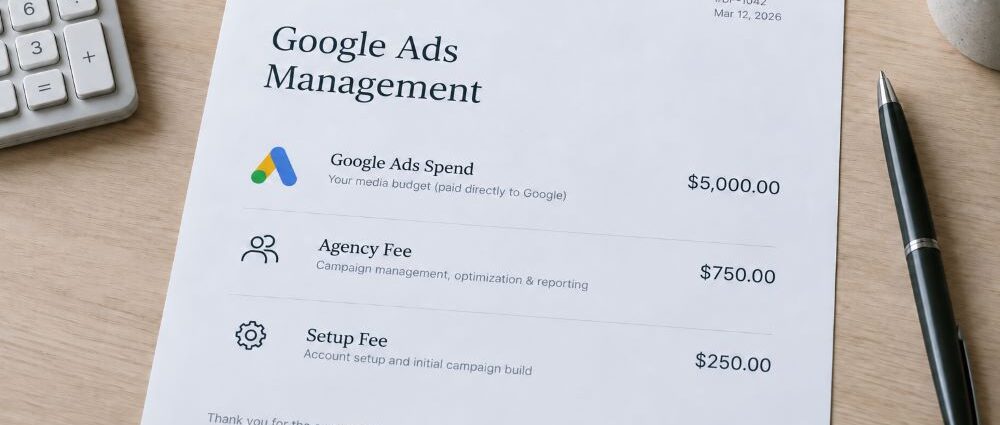
A $10,000 Google Ads budget does not necessarily mean a $10,000 monthly advertising bill. If an agency charges another $1,500 to manage the account, the business is committing $11,500 before any separate setup, landing-page or tracking work enters the picture. Agency proposals do not always make that distinction as clearly as they should.
Google Ads management fees may appear as a percentage of ad spend, a flat monthly retainer, a hybrid model or an hourly charge for limited work. Two proposals can use similar headline rates and still produce very different invoices once minimum fees, account complexity and extra services are included. The useful comparison starts with what the business actually pays for management and what work sits behind that number.
Google Ads Management Fees Are Separate From Ad Spend
Ad spend pays Google for traffic. The management charge pays the people responsible for campaign structure, bidding, testing, measurement and ongoing decisions. Calling both costs a single “Google Ads budget” hides where the money is actually going.
Consider a company spending $10,000 per month on media and another $1,500 on management. Its recurring commitment is $11,500, while a $2,000 setup project would push the first month to $13,500. Only $10,000 of that total buys media.
The distinction becomes more useful when several agency proposals arrive at once. One firm may separate every charge, another may present a combined monthly investment, and a third may bill onboarding independently. Putting media, recurring management and one-time work into the same categories makes those offers much easier to compare.
What Google Ads Management Costs in 2026
Published 2026 pricing offers a useful reference point, but there is no universal Google Ads rate card. OuterBox’s PPC pricing data places monthly management in broad ranges that rise with media spend while acknowledging that account complexity can shift the final fee considerably.
| Monthly Ad Spend | Published Monthly Management Range |
|---|---|
| $1,000–$5,000 | $500–$2,000 |
| $5,000–$25,000 | $1,500–$5,000 |
| $25,000–$100,000 | $4,000–$12,000 |
| $100,000+ | $10,000–$25,000+ |
Those wide bands are more useful than a single supposed average. A $20,000 Search account in one market with reliable conversion tracking may require less attention than a $10,000 account spread across Search, Shopping, Performance Max, several locations and offline conversion imports.
Spend still influences Google Ads agency pricing, particularly under percentage-based contracts. It tells a prospective client much less about operational difficulty, measurement requirements or the level of senior involvement behind the fee.
Four Ways Agencies Price Google Ads Management
Google Ads management pricing usually follows one of a few recognizable structures. What changes from agency to agency is how quickly the fee moves when budget, workload or account scope changes.
Percentage of Ad Spend
Under percentage pricing, the agency invoice rises with media spend. A 15% charge equals $1,500 on a $10,000 monthly budget and $7,500 once spend reaches $50,000.
Published pricing references commonly put this type of fee around 10%–20% of ad spend, but the percentage alone does not show whether the deal is attractive. A larger budget may add campaigns, testing and reporting work, or it may simply send more money through a stable structure.
Flat Monthly Retainer
A flat retainer keeps the management charge predictable even when media spend moves around. This can suit an established account whose workload stays relatively stable from month to month.
Scope still matters more than the label. A $1,500 retainer covering tracking reviews, active testing and senior strategy is not equivalent to a $1,500 package centered on routine monitoring and a monthly report.
Hybrid Pricing
Hybrid models combine a base retainer with a spend-related charge, often after the account crosses a defined threshold. This can give smaller accounts a workable minimum without making larger budgets scale indefinitely at one straight percentage.
The useful details are the base fee, threshold and percentage above it. Two agencies can both advertise hybrid pricing while producing very different costs at the same media budget.
Hourly and One-Time Fees
Hourly work fits audits, restructures, tracking cleanup and limited consulting more naturally than full ongoing management. Clutch’s PPC pricing guide currently lists $100–$149 per hour as the most common PPC agency rate and shows the same range for Google Ads services.
That number is useful for defined project work, but it should not be multiplied by a guessed number of hours to manufacture a monthly benchmark. Retainers bundle communication, responsibility and strategic oversight differently from a one-off audit or rebuild.
The Minimum Fee Can Matter More Than the Percentage
A percentage becomes less straightforward once the contract includes a minimum. Suppose an agency charges 15% of ad spend but requires at least $1,000 per month. Smaller advertisers no longer pay an effective 15% management rate.
Effective management rate = management fee ÷ monthly ad spend × 100
| Monthly Ad Spend | 15% Calculation | Actual Fee With $1,000 Minimum | Effective Rate |
|---|---|---|---|
| $2,500 | $375 | $1,000 | 40% |
| $5,000 | $750 | $1,000 | 20% |
| $7,500 | $1,125 | $1,125 | 15% |
| $10,000 | $1,500 | $1,500 | 15% |
| $25,000 | $3,750 | $3,750 | 15% |
The $1,000 minimum is only an illustration, not a claimed industry standard. What the calculation reveals is the gap between the percentage advertised in the pricing model and the percentage the client effectively pays at a lower budget. At $2,500 of spend, the example behaves like a 40% management rate.
That result does not automatically make the fee excessive. Reporting, tracking checks and strategic attention do not become four times easier simply because an advertiser spends one-quarter as much on media. Calculating the effective rate simply makes the minimum visible before the contract is signed.
When Percentage Pricing Starts Getting Expensive
At larger budgets, the same model creates the opposite question. A fixed percentage can make the management invoice climb sharply even when the account itself has not become equally complicated.
| Monthly Ad Spend | Management Fee at 15% |
|---|---|
| $10,000 | $1,500 |
| $25,000 | $3,750 |
| $50,000 | $7,500 |
| $100,000 | $15,000 |
Whether $15,000 is expensive depends on what happened to the workload on the way from $10,000 to $100,000. A national ecommerce program may add product groups, feeds, markets and testing cycles as budget rises, giving the agency much more to manage.
A mature campaign can behave differently. If most of the structure stays intact and the business simply funds proven campaigns more aggressively, media spend may grow much faster than management effort. A tiered percentage or negotiated retainer can then follow the workload more closely.
Account Complexity Can Matter More Than Spend
Two companies spending $20,000 per month can create very different workloads. Multiple locations, Shopping feeds, Performance Max, several conversion actions, offline conversion imports, CRM data and call tracking all add layers that a simple budget figure does not reveal. Frequent landing-page or creative testing can add more work on top.
Measurement is often the hidden part of that complexity. A lead-generation company may not know which clicks became revenue until weeks after the form submission, requiring the agency to work with offline conversions and lead-quality feedback instead of optimizing around raw lead counts.
A smaller account with complicated attribution may therefore need more specialist attention than a larger one with clean tracking and a simple funnel. Media budget tells the agency how much money it controls, not how difficult the account is to understand.
What the Monthly Management Fee Should Cover
A useful proposal makes recurring work visible instead of hiding it behind the word “management.” Without that detail, similar retainers can describe services that barely resemble one another.
- campaign and budget management;
- search-term review and negative-keyword work;
- bidding and budget pacing oversight;
- ad copy and asset testing;
- conversion-tracking checks;
- landing-page recommendations;
- performance reporting;
- regular strategic reviews.
Not every related task belongs inside the standard retainer. Landing-page development, full creative production, Merchant Center rebuilds, advanced tracking implementation, CRM integration or CRO can reasonably carry separate charges.
Setup deserves the same clarity. A Google Ads setup fee can make sense when an agency is rebuilding campaigns or repairing measurement before ongoing optimization begins. The proposal should explain what that charge produces and where setup ends and recurring management begins.
A Lower Quote Can Hide a More Expensive Scope
Suppose Agency A quotes $900 per month while Agency B asks for $1,800. The first offer looks dramatically cheaper until the detailed scope shows separate charges for conversion tracking, landing-page work, feed management and strategy sessions. Agency B may already include several of those services.
A practical comparison is a scope-normalized fee. This is not an industry metric; it is simply a way to put proposals on roughly equal footing by adding the services the account actually needs to each base price. The resulting number is often more useful than comparing retainers with different boundaries.
The exercise can also expose unnecessary scope. A longer list of deliverables does not create value if half of those services have little relevance to the account. The goal is comparable work, not the largest package.
How to Compare Two Google Ads Agency Quotes
Once competing offers are translated into the same terms, much of the ambiguity disappears. A practical comparison should:
- separate media spend from management;
- calculate the effective management percentage;
- identify minimum fees and spend thresholds;
- compare the work included in each scope;
- add setup and necessary extra services;
- confirm account ownership and data access;
- check contract length and exit terms;
- identify who will actually manage the account.
Price now sits beside the factors that determine how the account will actually operate. Specialization, operating model and account fit can separate firms that look similar on paper, which is why those factors also matter when comparing a Google Ads management company shortlist.
The identity of the day-to-day manager is particularly easy to overlook. A senior strategist may run the sales call and design the initial plan, while routine optimization later moves to another team member. Buyers should know who makes bidding, testing and budget decisions after onboarding.
What Is a Reasonable Google Ads Management Fee?
No dollar amount becomes reasonable simply because it falls inside a published range. A small advertiser may face a high effective percentage because the agency has a minimum fee, while a large account can see percentage pricing climb faster than the work required to manage it.
Scope can change the answer just as much. A lower retainer with weak measurement support may create more operational cost than a higher fee that resolves tracking problems affecting campaign decisions. The same issue appears in broader advertising agency pricing, where billing structure and service scope can matter as much as the monthly headline number.
A reasonable Google Ads management fee is one the business can trace back to a clear pricing method and a clear workload. It should also be obvious what would cause that fee to rise or fall as the account changes.
The Fee Only Makes Sense in Context
Google Ads management fees become useful numbers after media spend, recurring management and one-time work have been separated. From there, the business can calculate the effective rate, inspect the included scope and see whether the pricing model still behaves sensibly at its current budget.
The lowest retainer does not guarantee the lowest acquisition cost, just as the highest one does not guarantee stronger management. A $1,500 fee also looks very different beside $3,000 of media spend than beside $30,000, and even that comparison remains incomplete until the buyer knows who is doing the work and what the campaigns are producing. At that point, Google Ads management pricing stops being a percentage on a proposal and becomes an economic decision.