
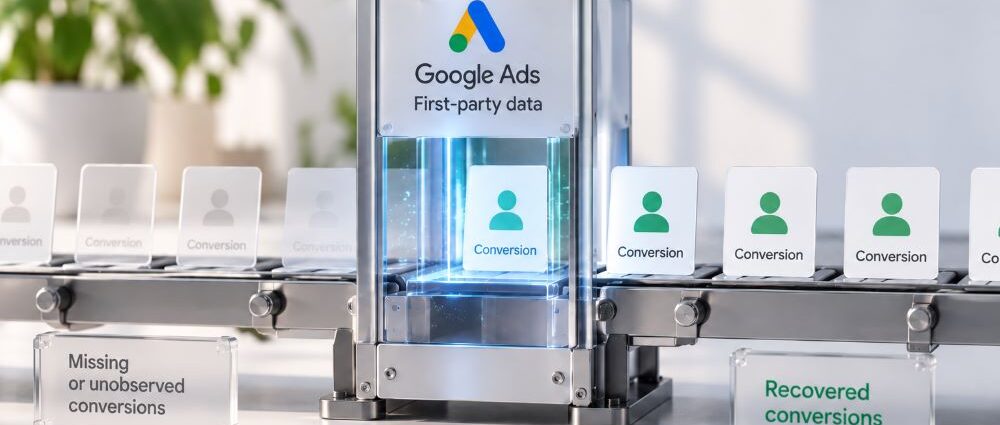
Google introduced the Google Ads Data Strength Uplift Metric in September 2026 as a way to quantify additional conversions recovered through an advertiser’s first-party data setup. At first glance, that sounds like another performance number: improve the data foundation, see more conversions, and calculate the gain. In practice, the metric sits closer to measurement quality than campaign performance.
A recovered conversion is one that stronger measurement helps Google capture or report; it is not automatically a new sale created by advertising, an incremental customer, or even a qualified lead. Those outcomes sit at different points in the measurement chain. For advertisers using CRM data, offline conversions, enhanced conversions, or other first-party signals, Data Strength Uplift can show whether a stronger setup is recovering activity that would otherwise be missing from the reported picture.
Its usefulness depends on keeping that role clear. Treating the number as another performance score risks turning a measurement improvement into a business claim the metric itself does not support.
What The Google Ads Data Strength Uplift Metric Measures
Google announced the metric on September 10, 2026 as part of its broader September 2026 measurement update, which also covered first-party signals, Data Manager, Google tag gateway, Meridian, and GeoX. Google describes Data Strength Uplift as the additional conversions recovered by an advertiser’s first-party data setup. The word “recovered” is central to that definition because it points to visibility gained through better measurement rather than demand automatically created by advertising.
Better tagging, matching, or connected first-party data may allow Google Ads to observe a conversion that the previous setup missed. Reporting becomes more complete even though the customer action itself may have happened either way. For analysis, Data Strength Uplift is best treated as a measurement-recovery signal.
Google’s own product example shows the metric reporting additional conversions over a recent period. That interface example illustrates what the measurement can surface, but it should not be interpreted as a promised uplift for another account.
Where The Uplift Can Come From
The broader Data Strength framework centers on the quality, completeness, and connectivity of first-party signals. Google Ads Data Manager provides a centralized way to connect data from websites, apps, physical stores, CRM systems, and other sources for measurement and advertising use.
An advertiser may recover more conversions after fixing tag coverage, passing stronger first-party identifiers, importing offline outcomes, or connecting customer data that previously sat outside the advertising platform. Which improvement matters most depends on the business model and where information is currently being lost.
A B2B advertiser importing qualified opportunities from a CRM has a very different measurement chain from an ecommerce business improving website conversion matching. Both may show a positive uplift, but the same headline percentage can represent very different underlying changes.
Recovered Conversions Are Not Incremental Conversions
A measurement improvement and a business-performance improvement can appear together, but they are not interchangeable. Suppose a campaign originally reports 1,000 conversions and, after an advertiser improves its first-party measurement setup, the system reports 1,080 comparable conversions. The account now has better visibility into customer actions, yet that does not establish that advertising created 80 additional customers.
Some of those conversions may simply have become observable after previously being missed. Incrementality asks a different question: would those outcomes have happened without the advertising? Google separates these layers in its September measurement update, discussing stronger signals and recovered conversions under Data Strength while treating Meridian and GeoX as tools for causal measurement and incremental demand.
This distinction matters when a tracking change creates an apparent jump in performance. A campaign can report more conversions without the ads themselves becoming more persuasive or profitable, so the implementation date needs to remain visible in any before-and-after analysis.
A Simple Lead Generation Example
Imagine a Google Ads account that previously recorded 200 form submissions per month. After its first-party measurement improves, another 20 conversions become observable, taking the reported total to 220. The business now sees more of the activity that was already taking place, but it still needs to know what happened to those submissions afterward.
If only 25% of the newly recovered leads qualify, the commercial interpretation looks very different from a situation in which 80% qualify, even though both accounts could show the same measurement uplift. The platform has improved its visibility; the business still has to judge the quality of what became visible.
Businesses passing CRM outcomes back into advertising platforms can use Google Ads lead quality tracking to connect extra measured volume with qualified leads and later outcomes. That keeps a reporting improvement from being mistaken for an automatic improvement in lead economics.
Google’s Published Uplift Numbers Need Separate Context
Google attaches several attractive percentages to its recent Data Strength messaging, but they do not describe one universal benchmark. The figures refer to different products, implementations, campaign types, and outcomes.
In its September measurement announcement, Google says advertisers building their data strength with Google tag gateway observe an average 14% conversion uplift. The same announcement reports more than 20% uplift for Demand Gen campaigns, supported by a separate dataset and methodology. A different Google Data Manager example reports an average 26% increase in incremental ROAS for advertisers connecting offline and app data through Data Manager, using Search campaigns bidding to conversion value over a defined April 2025 to April 2026 period.
Those percentages should not be blended into a statement such as “better Data Strength improves Google Ads performance by around 20%.” A conversion uplift, a Demand Gen performance uplift, and an increase in incremental ROAS do not measure the same result. Combining them would erase the differences in product, population, methodology, and business outcome.
The more defensible takeaway is narrower: stronger first-party measurement can materially change what an advertising system is able to observe and optimize toward. The size and commercial value of that change remain specific to the advertiser’s setup, conversion definitions, and data quality.
What A Stronger Data Setup Can Include
Improving Google Ads data strength is broader than switching on one tracking feature. The practical goal is to reduce gaps between what customers actually do and what the advertising platform can reliably observe.
Depending on the account, useful improvements can include:
- stronger Google tag coverage or Google tag gateway;
- enhanced conversions;
- offline conversion imports;
- CRM conversion and value data;
- app or physical-store signals;
- cleaner Data Manager connections;
- fixing diagnostics that reveal incomplete or unhealthy data flows.
A local service business that closes most customers by phone may gain much more from reliable offline qualified-lead imports than from another audience source. An ecommerce advertiser may have a different gap involving matching quality, website signals, or product-level conversion data.
Data Strength should not become a checklist score pursued for its own sake. The useful signals are the ones that make actual business outcomes easier to observe, evaluate, and optimize toward.
What Data Strength Uplift Does And Does Not Tell You
Several Google Ads measurements can improve at the same time while answering different questions. Keeping those layers separate makes it easier to see whether a change occurred in tracking, lead quality, revenue, or genuine incremental demand.
| Measurement Layer | Question It Helps Answer | What It Does Not Prove |
|---|---|---|
| Reported conversions | How many configured conversions did the platform record? | Whether every conversion is valuable |
| Data Strength Uplift | How many additional conversions were recovered through stronger first-party measurement? | That the same number of new customers was created |
| Qualified leads | Which recorded leads met the business’s qualification criteria? | That advertising caused every qualified lead |
| Conversion value or revenue | What commercial value did the account assign or import? | True incrementality by itself |
| Incrementality measurement | Which outcomes did the marketing activity actually cause rather than merely coincide with? | Whether every underlying tracking signal is complete |
An account can improve measurement coverage and recover more conversions while still discovering that lead quality is poor. The reverse can also happen: a business may have excellent CRM qualification data but lose useful signals before conversions reach that CRM or the advertising platform.
Data Strength Uplift adds another diagnostic point to this chain. It helps identify whether stronger first-party measurement is allowing the platform to observe more of the conversion activity that matters without pretending to answer every question that follows.
How To Read An Uplift Without Overvaluing It
A positive uplift deserves investigation before it influences a budget decision. Start by identifying what changed in the measurement setup, when the change happened, and whether the recovered conversions represent a business action the account genuinely values.
Conversion definitions are an obvious place to look first. If the account counts duplicate events, secondary goals, or weak micro-conversions as primary outcomes, recovering more of them can improve platform reporting without producing better customers.
Timing matters just as much. A significant tracking implementation can create a visible break in the data series, so comparing the post-change conversion total with an older period using weaker measurement may exaggerate apparent growth. That is especially risky when reports circulate outside the team that made the tracking change.
Lead-generation accounts need another filter after that: qualification. More observable leads become more useful only when the business can determine whether the added volume maintains acceptable qualification rates, sales rates, and customer value.
Before treating Data Strength Uplift as evidence for a bidding or budget change, check:
- whether the conversion action reflects a meaningful business outcome;
- whether duplicate or secondary actions are inflating totals;
- what measurement change occurred and when;
- whether recovered leads maintain the previous qualification rate;
- whether CRM, opportunity, or revenue data supports the apparent improvement.
These checks keep the metric tied to the problem it can actually diagnose and reduce the risk of presenting a measurement improvement as automatic revenue growth.
Where Data Strength Fits In Lead Generation Economics
Lead generation already contains several places where a superficially better number can hide weaker business economics. A campaign with a $50 CPL may look stronger than one with a $75 CPL, but if only 10% of the cheaper leads qualify while half of the more expensive leads qualify, the qualified-lead economics reverse.
That is why Google Ads lead generation benchmarks are most useful as the beginning of an analysis rather than the final target. CPC, conversion rate, and CPL describe important parts of acquisition performance, but a business eventually needs to connect those figures with qualification and revenue.
Data Strength introduces an earlier question: how much of the actual conversion activity is the advertising platform able to observe in the first place? That makes measurement coverage part of the same economic chain rather than a separate technical concern.
The sequence looks more like:
click → lead → measured lead → qualified lead → opportunity or sale
A weakness at one stage can distort the interpretation of another. Better measurement improves the evidence entering that chain, but it does not remove the need to examine what happens after a conversion is recorded.
What To Check Before Changing Budgets Or Targets
New metrics often acquire optimization rules before advertisers have enough evidence to justify them. Data Strength Uplift is more useful initially as a diagnostic and validation signal, particularly when an account has recently changed how it captures or imports conversions.
If the number changes materially, identify what changed in the data foundation first. A recent CRM connection, enhanced-conversions implementation, tag gateway setup, offline import, or repaired data source may explain the difference more directly than a sudden improvement in campaign quality.
The next step is to compare equivalent periods. A post-implementation period using stronger measurement should not be placed casually beside an older period with known signal loss and presented as pure conversion growth.
Downstream outcomes provide the final check. If recovered conversions preserve or improve qualification rate, revenue quality, and cost efficiency, the richer measurement picture becomes more useful for bidding and planning. If the additional volume is concentrated in weak actions, the account may have gained measurement coverage without gaining equally useful optimization data.
Treat Data Strength Uplift As Measurement Evidence
The Google Ads Data Strength Uplift Metric gives advertisers something that has traditionally been difficult to quantify: evidence that a stronger first-party data setup can recover conversion information that weaker measurement misses. That matters because tracking improvements often happen behind the scenes while campaign teams focus more visibly on bids, budgets, creatives, and CPL.
Its usefulness depends on keeping the number in the right layer of the decision process. Combined with CRM qualification, revenue, and incrementality data, Data Strength Uplift becomes part of a stronger evidence chain rather than a standalone verdict on campaign performance.
For a lead-generation advertiser, the useful response is not simply to chase the highest possible uplift. A stronger approach is to improve measurement coverage, understand which signals were previously missing, connect the recovered activity with qualification and revenue, and then use that richer evidence to make campaign decisions.