
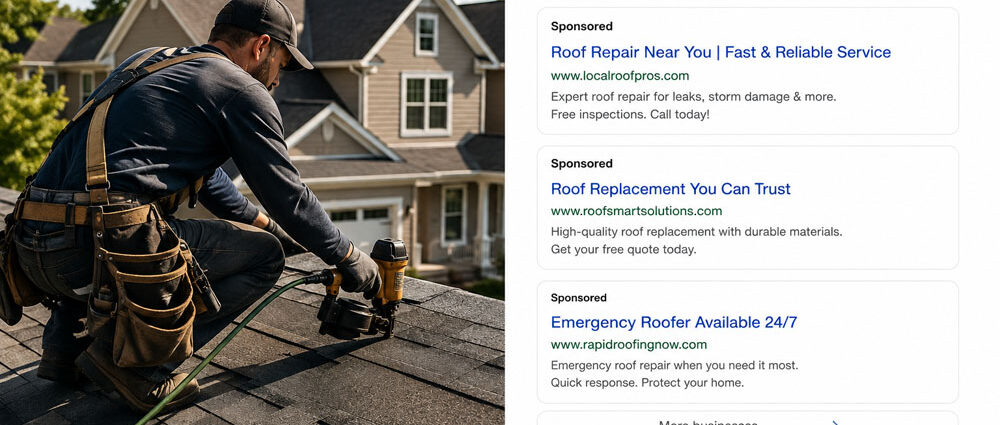
Roofing PPC gets expensive quickly when campaign structure, service areas, landing pages, or lead tracking are loose. Choosing the right roofing PPC agency is therefore less about finding the company with the loudest promise and more about finding a team that can turn high-intent local searches into qualified calls, estimates, and profitable jobs.
The 11 Roofing PPC Agencies below were selected for different reasons. Some publish detailed roofing-specific paid-media cases. Others stand out for attribution, multi-location management, landing-page work, Local Services Ads, or a broader contractor marketing system. The purpose of the shortlist is to show where each provider appears strongest and, at the same time, where a roofing company should ask harder questions before signing.
11 Roofing PPC Agencies at a Glance
The shortlist includes roofing specialists as well as larger performance agencies with relevant contractor experience. Importantly, this mix reflects the fact that roofing companies can have very different marketing priorities depending on their size, market, and growth stage. For example, a local roofer testing Google Ads for the first time may primarily need straightforward campaign management, careful budget control, and a reliable flow of qualified leads. In contrast, a regional roofing company may require a much broader strategy that combines paid search with SEO, Local Services Ads, landing page optimization, website development, call tracking, and revenue attribution. As a result, comparing agencies with different strengths can help roofing businesses identify a provider that fits both their current needs and their longer-term growth plans.
The cost column uses the strongest public reference available for each provider. Depending on the agency, that may be a published management fee, recommended ad spend, budget from a roofing case study, or an independent project-size benchmark.
| Agency | Best Fit | Strongest PPC Signal | Public Cost Reference |
| WebRunner Media | PPC-first roofing growth | Multiple roofing paid-media cases | $3K–$5K/mo cited as a common starting ad spend; roofing cases at ~$30K–$40K/mo marketing budget |
| Profit Roofing Systems | Roofing-specific PPC | Roofing Google Ads and LSA cases | $1.9K Google Ads spend in published roofing case |
| Contractor Marketing Pros | Ads plus lead management | PPC, LSA, CRM and contractor cases | $20K Facebook ad spend in published roofing campaign; agency guidance puts heavy-PPC marketing programs at $8K+/mo |
| Silverback Strategies | Multi-market growth | Paid media tied to revenue | $10K+ minimum project size on Clutch |
| Hook Agency | PPC plus website | Roofing Google Ads case data | Published package from $3.5K/mo, including Google Ads management |
| RYNO Strategic Solutions | Larger home-service businesses | Paid media and attribution infrastructure | Quote required; no reliable public PPC fee disclosed |
| Roofing Webmasters | Roofing-only marketing | Deep roofing specialization | $3K–$5K/mo suggested market-entry Google Ads spend |
| Thrive Internet Marketing Agency | Full-service digital marketing | Roofing PPC performance case | Clutch: $1K+ minimum project; $100–$149/hr |
| Scorpion | Larger roofing operations | Revenue-focused marketing system | Clutch: $200K–$999K most common overall project size among reviewed projects |
| Falcon Digital Marketing | Focused PPC management | Roofing PPC and account control | $3K Google Ads example plus separate management fee; $500 setup fee in most cases |
| Blue Grid Media | Google Ads plus LSA | Contractor-only paid-search focus | Google Ads management from $695/mo; Ads + LSA from $995/mo |
Cost references are not directly comparable. Ad spend is money paid to advertising platforms, while a management fee pays the agency to build and optimize campaigns. Case-study budgets show what a particular client spent, not the minimum required to hire that agency.
Where an agency does not publish PPC pricing, we have not estimated it. Independent project-size data is labeled separately because a company-wide project minimum is not necessarily the same as the monthly cost of roofing PPC management. In other words, these figures should not be treated as exact pricing for a roofing advertising campaign. Instead, they provide additional context about the typical size and scope of projects an agency is prepared to handle. For example, a higher minimum project size may indicate that the provider primarily works with established roofing companies or businesses planning larger, multi-channel campaigns. By contrast, a lower threshold may be more accessible to local contractors testing paid search with a smaller initial budget. Therefore, these figures are best used to understand the likely scale of an engagement, compare providers more accurately, and set realistic expectations before requesting a customized proposal.
How We Evaluated Each Roofing PPC Agency
A roofing service page by itself does not establish paid-search expertise. We weighted practical evidence, campaign depth, measurable outcomes, tracking, transparency, and business fit.
- Roofing-specific evidence: relevant clients, campaigns, and case studies.
- PPC depth: targeting, bidding, negative keywords, LSAs, and CRO.
- Business outcomes: qualified leads, estimates, sales, and revenue.
- Tracking: calls, conversions, CRM data, and attribution.
- Transparency: pricing, account access, reporting, and contracts.
- Business fit: suitability for different contractor sizes and growth stages.
No single figure decided inclusion. Roofing results carried more weight than broad marketing claims, while company-scale data was used when comparable campaign results were not public. That approach keeps the comparison focused on information a contractor can actually use during vendor selection.
11 Roofing PPC Services Compared
The agencies below are not interchangeable. A few are built almost entirely around roofing or home services; others bring larger paid-media teams, stronger analytics, or a broader marketing stack.
The useful comparison is therefore not “Which agency is best?” but “Which agency matches this roofing company’s current problem, budget, and operating model?”
1. WebRunner Media
Best fit: roofing companies that want paid media to become a primary growth channel.
WebRunner Media has one of the more detailed public roofing paid-media case libraries in this group. In one case, a metal-roofing contractor generated around 300 exclusive roofing leads per month through Google and Facebook campaigns. The planning model used a $40,000 monthly marketing budget and a maximum target cost per lead of roughly $175.
Another case is useful for a different reason: it compares traffic sent to a standard website with traffic sent to dedicated landing pages. WebRunner reported that the landing-page approach cut cost per lead by about $75 from a previous $196 level and generated 63 additional leads per month from the same budget. Those figures are agency-reported, but they give buyers more to examine than a generic promise of “more leads.”
Where it looks strongest:
- roofing-specific paid-media evidence;
- landing-page and conversion testing;
- search and social advertising;
- experience with larger acquisition budgets.
The model appears better suited to a contractor ready to build a sustained acquisition program than to a small roofer looking for light account maintenance. Buyers should also ask how closely the proposed budget and market resemble the published cases. WebRunner is most persuasive when scale and conversion improvement are the main objectives.
2. Profit Roofing Systems
Best fit: contractors that want an agency built specifically around roofing marketing.
Profit Roofing Systems has a straightforward advantage: roofing is central to the company rather than one vertical among many. One published Google Ads case for a Georgia roofing contractor reports 61 leads from $1,900 in ad spend, equivalent to a reported $31 cost per lead. The same campaign produced an average conversion rate of about 30%, with results varying by city.
The agency also publishes roofing-specific work across Google Ads, Local Services Ads, Facebook campaigns, and broader multichannel marketing. Its case library therefore provides more direct industry evidence than a generic claim that the team understands local service businesses. The specialization also extends across several roofing PPC services rather than a single search-ad format.
Where it looks strongest:
- dedicated roofing focus;
- roofing PPC case studies;
- Google Ads and LSA experience;
- multichannel lead generation.
The published numbers should not be treated as a forecast for another city, budget, or contractor. A roofing-only focus is valuable when the entire brief sits inside the trade, but it may matter less to a diversified company that wants one agency across several business lines. Profit Roofing Systems belongs near the top of the shortlist when direct roofing experience is the deciding factor.
3. Contractor Marketing Pros
Best fit: roofing businesses that want advertising connected to CRM visibility and lead handling.
Contractor Marketing Pros is less about isolated ad management and more about the path from campaign to sales pipeline. Its Adam Quenneville Roofing case reports 4,108 total leads, including 2,284 phone calls, 959 website forms, and 284 paid-search leads. The same case reports revenue growth from $3 million to more than $10 million in under 36 months, although that result reflects a wider marketing program rather than PPC alone.
That broader view can be useful in roofing, where lead quality often breaks down after the click. Missed calls, weak source tracking, slow follow-up, and poor qualification can make a healthy ad account look unprofitable. Contractor Marketing Pros is therefore more relevant when management wants to see what happens after Google sends the visitor.
Where it looks strongest:
- PPC and LSA within a broader lead-generation system;
- call and CRM tracking;
- contractor specialization;
- paid and organic acquisition working together.
A roofer that wants only Google Ads management should clarify how much of the proposal sits outside paid media. The broader system can add value, but it also changes the scope, cost, and number of moving parts. This agency is easier to justify when lead handling and attribution are part of the problem, not just campaign setup.
4. Silverback Strategies
Best fit: established roofing businesses that need stronger measurement across markets.
Silverback Strategies earns its place mainly through measurement and multi-market performance rather than roofing-only positioning. Its work with Long Roofing is the clearest example: Silverback reports a 429% increase in online leads and a 242% increase in revenue as the contractor expanded into a new geographic market.
The more important point for a larger roofer is the connection between media data and business outcomes. A company operating across several territories needs to know whether one market is producing profitable replacements while another is filling the pipeline with lower-value work. Silverback’s emphasis on CRM data, conversion optimization, and revenue attribution addresses that problem more directly than a basic lead-count report.
Where it looks strongest:
- revenue attribution;
- cross-market campaign strategy;
- CRO and measurement;
- established performance-marketing infrastructure.
The Long Roofing figures cover a broader growth program and should not be read as PPC-only lifts. Silverback may also be more sophisticated than a small contractor needs for an initial local campaign. It becomes a stronger fit as spend, market count, and reporting complexity increase.
5. Hook Agency
Best fit: growth-oriented contractors that want PPC to work alongside a strong website.
Hook Agency is heavily focused on home-service contractors, and its case material is useful because it distinguishes ordinary conversions from leads considered ready for sales follow-up. In its Badgerland Exteriors case, Hook reports 121 marketing-qualified leads during 2025, an average $291.76 cost per qualified lead, and a $3,500 monthly Google Ads budget. The same case lists an average cost per conversion of about $143.
That distinction matters. A roofing campaign can look efficient on a dashboard while producing forms that never become serious estimates. Hook’s broader model also connects paid traffic with website quality, conversion paths, and brand presentation, which can be valuable when the site itself is limiting performance.
Where it looks strongest:
- contractor specialization;
- qualified-lead measurement;
- PPC integrated with website work;
- broader conversion strategy.
A contractor with a strong website and an internal marketing team may not need the surrounding services. The Badgerland numbers also come from one account and should be used as evidence, not as a promised benchmark. Hook is most relevant when the roofer suspects that the problem sits partly between the click and the lead.
6. RYNO Strategic Solutions
Best fit: larger roofing and home-service companies that want a broader acquisition stack.
RYNO Strategic Solutions has less public roofing-specific PPC detail than several agencies above, but its scale is relevant for larger operators. After its 2024 merger with Blue Corona, RYNO states that it has more than 300 full-time employees and serves nearly 1,000 local businesses across the United States.
Its service mix includes paid media, Local Services Ads, SEO, email, call intelligence, website services, and other home-service marketing functions. That breadth can be useful when a contractor no longer sees PPC, call handling, website conversion, and reporting as separate projects.
Where it looks strongest:
- substantial home-services infrastructure;
- paid media plus LSA;
- call intelligence and reporting;
- capacity for larger marketing operations.
Headcount and client count show operating scale, not campaign quality. A buyer should still ask for current roofing PPC results from businesses with similar locations, spend, and service mix. RYNO makes the strongest case when the contractor needs a broad acquisition platform rather than a narrow paid-search engagement.
7. Roofing Webmasters
Best fit: roofing companies that prefer an industry-exclusive marketing provider.
Roofing Webmasters has one of the longest vertical histories in this group. The company states that it has more than 16 years of digital marketing experience with approximately 1,000 roofing companies across North America.
Its current services cover paid and organic search, website design, local visibility, and related digital tools. The value of that specialization is not simply familiarity with roofing terminology. A team that has worked across many roofing markets should already understand the differences between emergency repair, replacement, commercial work, specialty materials, storm demand, and service-area economics.
Where it looks strongest:
- long roofing-specific track record;
- knowledge of contractor search behavior;
- search and website integration;
- roofing-only positioning.
The strongest public numbers relate to company experience and industry reach rather than one directly comparable current PPC case. Contractors considering Roofing Webmasters primarily for paid media should therefore request recent Google Ads examples from similar markets. Its clearest advantage is accumulated roofing context, not a single headline campaign statistic.
8. Thrive Internet Marketing Agency
Best fit: contractors that prefer PPC inside a broader digital-marketing engagement.
Thrive Internet Marketing Agency sits between a vertical specialist and a general full-service agency. It has a dedicated roofing PPC agency offering and a residential roofing case with channel-level paid-search data. Over the documented five-month engagement, Thrive reports a 7.48% PPC conversion rate, 55 PPC conversions, and 65 PPC leads.
The company combined paid search with SEO, social advertising, and other digital work, so the wider campaign results cannot be assigned to PPC alone. Even so, the presence of roofing-specific paid-search metrics makes the case more useful than a service page with no performance evidence.
Where it looks strongest:
- roofing-specific PPC metrics;
- PPC plus SEO and website services;
- full-funnel digital marketing;
- multichannel execution.
A full-service relationship can reduce vendor coordination, but it also makes it important to know who will manage the paid-search account day to day. The published case is evidence of capability, not a forecast for a new account. Thrive is a reasonable choice when PPC is one part of a larger digital brief.
9. Scorpion
Best fit: established roofing companies that want marketing tied more closely to jobs and revenue.
Scorpion approaches roofing as part of a larger home-services marketing system rather than as a standalone Google Ads service. Its Onit Roofing example reports 113% more leads and a 63% reduction in cost per lead after the contractor adopted Scorpion’s RevenueMAX approach.
For a mature roofing business, the more interesting part is the emphasis on connecting acquisition data to the jobs the company actually wants. Once lead volume is high enough, the key question changes from “How many forms did we get?” to “Which campaigns are producing the most valuable work?” Scorpion’s platform-oriented approach is built around that later-stage problem.
Where it looks strongest:
- home-services specialization;
- integrated marketing technology;
- lead-quality and revenue measurement;
- suitability for mature acquisition operations.
The published roofing result reflects a broader marketing platform, not an isolated PPC test. Smaller contractors should compare the total scope and cost with simpler specialists before assuming more technology is automatically better. Scorpion becomes easier to justify when the business already has enough volume and CRM data to use deeper attribution.
10. Falcon Digital Marketing
Best fit: roofing businesses looking for focused PPC management and direct account control.
Falcon Digital Marketing is an interesting counterpoint to the larger full-service agencies. It publishes fewer roofing performance cases, but it provides unusually specific operating information. Falcon states that its team has managed roofing PPC campaigns for more than 12 years across monthly advertising budgets ranging from $500 to $500,000.
The agency also states that clients retain ownership and access to their advertising accounts and that management works on a monthly basis rather than a long lock-in contract. Those details matter to buyers who want flexibility and control without buying a large surrounding marketing stack.
Where it looks strongest:
- PPC-centered service model;
- experience across a wide range of budgets;
- account ownership and transparency;
- geographic and campaign-level control.
The budget range shows experience, but it does not replace a current roofing case with lead-quality or revenue data. Prospective clients should ask for examples from contractors operating in comparable markets. Falcon is most attractive when focused paid-media management and account control matter more than agency breadth.
11. Blue Grid Media
Best fit: contractors that want Google Ads and Local Services Ads managed together.
Blue Grid Media is one of the more transparent smaller providers in the shortlist. The company reports more than $4 million in ad spend managed across contractor trades, more than six years running paid search for contractors, and a cap of 20 clients per account manager. Its Google Ads management currently starts at $695 per month, with published spend-based tiers.
The account-manager limit is a useful operational detail because it gives buyers something concrete to compare during sales calls. Blue Grid’s positioning is also tightly centered on contractor paid search and coordination between Google Ads and Local Services Ads rather than a large menu of unrelated marketing services.
Where it looks strongest:
- contractor-only paid-search focus;
- public pricing;
- Google Ads and LSA coordination;
- explicit account-manager capacity limits.
The $4 million figure covers several contractor trades, not roofing alone, and the agency is smaller than many providers above. Businesses that need national creative production or a large multichannel team may want more infrastructure. Blue Grid is a credible option when transparency, paid-search focus, and direct account attention carry more weight than agency size.
What Roofing PPC Company Should Actually Produce
Roofing PPC is easy to misread when the reporting stops at clicks or raw leads. A campaign can post a lower CPC and still be the weaker investment if the calls are poor, the jobs are too small, or the service area is wrong.
Before comparing agencies, it helps to separate three questions: what roofing PPC is meant to accomplish, what the agency is responsible for, and how campaign cost should be judged.
What Is PPC in Roofing?
Roofing PPC is paid advertising used to reach people searching for services such as roof replacement, emergency roof repair, storm restoration, commercial roofing, or specific roofing materials. In a conventional pay-per-click campaign, the advertiser typically pays when someone clicks the ad.
For a roofing contractor, the useful measurement chain is longer:
click → lead → qualified lead → estimate → sold job → revenue
That sequence explains why a more expensive click can still be the better buy. If it consistently reaches homeowners with higher-value projects and stronger intent, a higher CPC may produce a lower customer-acquisition cost than cheaper traffic.
What Does a PPC Agency Do?
A PPC agency researches demand, builds campaign structure, organizes keywords and ad groups, writes and tests ads, manages bids and budgets, controls geographic targeting, adds negative keywords, tracks conversions, and reallocates spend as performance changes.
For roofers, the job should also include understanding service intent and lead quality. Repair and replacement searches should not always be valued the same way, commercial demand may need separate treatment, and calls from outside the practical service area can burn budget quickly. The better agencies use feedback from sales or CRM data so optimization is based on useful opportunities rather than form volume alone.
How Much Do PPC Ads Cost?
There is no fixed price for roofing PPC because Google Ads uses an auction. CPC changes with competition, location, keyword intent, bidding, campaign quality, and market conditions. Current contractor benchmarks often place roofing clicks in competitive markets around $15–$50, but individual cities and search terms can fall well outside that range.
CPC is only part of the budget. A roofing company may also pay an agency management fee, invest in landing-page work and tracking, and run Local Services Ads alongside standard search campaigns. Those costs should be assessed against the quality and value of the opportunities produced.
A $35 click that repeatedly becomes a profitable roof replacement can be a better investment than a $15 click that rarely reaches an estimate. The useful numbers are therefore cost per qualified lead, estimate rate, close rate, customer-acquisition cost, and profit from sold jobs—not CPC in isolation.
How to Choose a Roofing PPC Agency
Start with evidence that resembles your own situation. Ask for roofing or comparable home-services accounts with similar budgets, markets, and services; identify who will manage the account; confirm that your business retains access to Google Ads; and find out whether reporting stops at leads or follows estimates and sales. Pricing should be compared as part of the complete acquisition model rather than as a standalone management fee.
| Your Situation | Prioritize |
| First PPC campaign | Clear fees, account ownership, targeting, call tracking |
| Weak website | PPC plus landing-page or website support |
| Established contractor | Qualified leads, CRO, attribution |
| Multi-location roofer | Market-level campaigns and reporting |
| Large ad budget | CRM integration and revenue tracking |
| PPC plus SEO needed | Full-service roofing marketing company |
| Strong internal marketing team | Specialist paid-media management |
A roofing marketing agency can be the better fit when paid search has to work alongside SEO, website improvements, Local Services Ads, and local visibility. A broader roofing marketing company may also be useful when several parts of the acquisition funnel need attention at once. By contrast, a focused roofing PPC company is easier to justify when those foundations already work and the main issue is paid-media performance.
The final choice should come down to fit, evidence, and operating transparency rather than the biggest number in a case study. A useful partner should be able to explain how budget moves from search query to qualified opportunity and how the account will be adjusted when lead quality changes. That is a more durable basis for choosing an agency than a promise of cheaper clicks.