
Google AI Mode has moved well beyond its experimental phase. In May 2026, Google said the product had passed 1 billion monthly active users worldwide, while AI Mode queries had more than doubled in every quarter since launch. Those numbers establish the scale, but they do not explain why AI Mode matters for search behavior.
The more revealing statistics concern how people use it. AI Mode queries are longer than conventional searches, follow-up questions are increasing quickly, and multimodal input is becoming common. Planning, product comparison, shopping research, and other decision-heavy searches are also growing faster than AI Mode overall.
Independent research adds a less comfortable part of the picture for publishers. A preregistered field experiment found that moving users into AI Mode reduced external publisher click-through by 18.8 percentage points compared with current Google Search. SE Ranking datasets also show how frequently Google-owned destinations and paid ads appear within the AI Mode environment.
These figures should not be mixed with AI Overviews statistics. AI Mode is a separate conversational search experience, and the datasets below measure AI Mode specifically.
Google AI Mode Statistics: Key Numbers for 2026
| Metric | 2026 figure | What it measures |
|---|---|---|
| Monthly active users | 1B+ | Global AI Mode users reported by Google |
| Query growth | More than 2× every quarter | Growth in AI Mode queries since launch |
| Average query length | About 3× traditional Search | Relative length of an AI Mode query |
| Follow-up query growth | More than 40% average per month | U.S. follow-up queries inside AI Mode |
| Multimodal searches | More than 1 in 6 | U.S. AI Mode searches using non-text input |
| Image-input growth | More than 40% month over month | U.S. image searches since launch |
| Planning-query growth | 80% faster than AI Mode overall | Relative growth over the previous six months |
| “Which” query growth | 40% faster than AI Mode overall | Relative growth over the previous six months |
| Brainstorming-query growth | 30% faster than AI Mode overall | Relative growth since launch |
| Image-creation query growth | More than 3× | Growth since the start of 2026 |
| External publisher CTR effect | -18.8 percentage points | Field experiment: AI Mode versus current Search |
| Google.com share of citations | 17.42% | 1.32M AI Mode citations studied |
| Commercial queries with text ads | 29.45% | 50,032-query U.S. ad dataset |
| Advertiser also cited organically | 11.53% | Overlap between paid placement and AI Mode citation |
Most of the behavioral figures come from Google’s AI Mode U.S. Insights. The 1B+ monthly-active-user figure is global, while most behavioral data applies to U.S. usage.
Google says its keyword- and query-specific figures use Google Trends data covering May 2025 through April 2026. The growth numbers therefore describe relative changes rather than the absolute share of all AI Mode searches represented by each category.
Google AI Mode Users Have Passed 1 Billion
AI Mode passed 1 billion monthly active users globally within roughly a year of its U.S. launch. Google also reported that AI Mode queries had more than doubled in every quarter since launch.
What Google has not published is equally important. There is no public figure showing what percentage of all Google searches now happen in AI Mode, so the 1 billion figure should not be treated as a proxy for query share. Monthly active users measure reach, not the proportion of search activity handled by the product.
Even with that limitation, AI Mode is no longer a niche search interface. Behavioral changes inside the product now involve a user base large enough to matter for publishers, advertisers, retailers, and companies that depend on organic search demand.
Google AI Mode queries are much longer than traditional searches
The average AI Mode query is about three times as long as a traditional Google Search query. Instead of compressing a need into a few terms, users are more likely to write a complete request with several conditions attached.
A person searching for a product, for example, can include price, location, size, preferences, and intended use in the first prompt. A travel query can contain dates, budget, transport preferences, and a request for an itinerary without splitting those details into several separate searches.
Google’s data supports that shift in wording. Frequent opening words include “what,” “how,” “I,” “is,” and “can,” while common terms include “find,” “information,” “identify,” “explain,” and “summarize.” The language looks less like a keyword string and more like a task given to a search system.
Follow-up queries are growing more than 40% per month
The first query is only part of the session. Google says follow-up queries in U.S. AI Mode increased by more than 40% on average per month, showing that users increasingly continue the same search instead of starting again from a blank box.
That makes the interaction closer to progressive research. Someone might start with a broad comparison, add a budget restriction, exclude one option, ask about availability, and then request a recommendation. Much of that refinement can happen without returning to a conventional results page.
Google has not disclosed what percentage of all AI Mode sessions contain follow-ups. The published 40% number refers to the growth of follow-up activity, not its overall share.
More Than 1 in 6 AI Mode Searches Are Multimodal
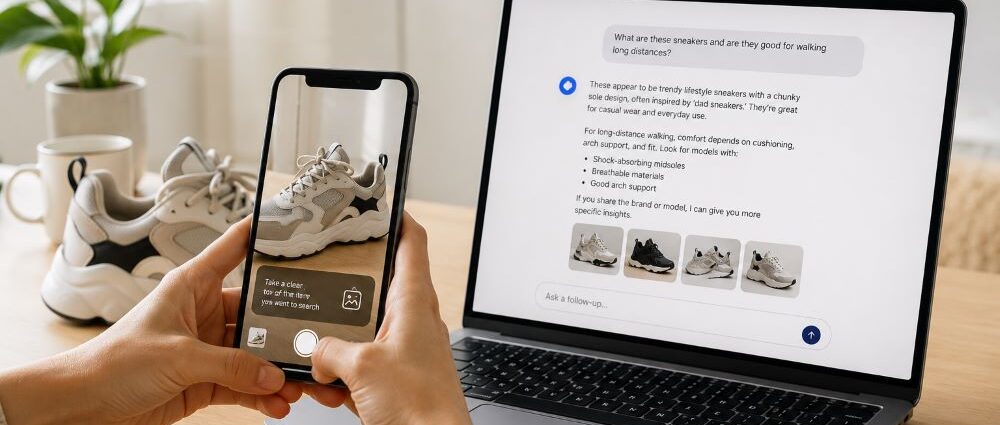
More than one in six U.S. AI Mode searches use multimodal input, according to Google. Voice and images allow users to begin a search without first converting what they see or hear into a precise text query.
Image-input searches have grown by more than 40% month over month since launch. A user can photograph an object, upload a screenshot, show a product, or submit a document and then ask what it is, where to buy something similar, whether two items are compatible, or how to solve a problem visible in the image.
That creates search demand that conventional keyword data may not capture very well. A visual search can begin with little or no descriptive language, while the useful context emerges later through follow-up questions.
Visual creation is growing too. Google says image-creation queries in AI Mode have more than tripled since the start of 2026, so visual interaction is developing in both directions: people ask Search to interpret images and increasingly use the same interface to create them.
Google AI Mode Usage Is Shifting Toward Planning and Decisions
Some of the fastest-growing AI Mode categories involve tasks that require more than retrieving a fact. Google reports that planning queries grew 80% faster than AI Mode queries overall during the six-month comparison period.
These searches include schedules, restaurant planning, travel itineraries, budgeting, exercise plans, to-do lists, and similar tasks where the user expects Search to organize several pieces of information into something usable. AI Mode is particularly suited to that format because the plan can be revised through additional prompts rather than rebuilt from the beginning.
The 80% statistic measures relative growth against AI Mode overall. It does not indicate that planning accounts for anything close to 80% of AI Mode traffic, but it does show that planning behavior is expanding considerably faster than the product’s broader query volume.
“Which” searches are growing as users narrow their options
Queries beginning with “which” increased 40% faster than AI Mode queries overall over six months. Google specifically noted growth in formulations such as “which of” and “which one,” wording that often appears when users have moved beyond discovery and are trying to select between alternatives.
That matters for commercial searches because product and service evaluation may now happen deeper inside Google. A shopper can ask which laptop fits a certain workload, which hotel is better for a particular trip, or which service provider matches a set of requirements before visiting any external site.
Brainstorming activity is moving in the same direction. Google says brainstorming-related queries grew 30% faster than AI Mode overall since launch, suggesting that users also turn to the product before they have settled on a fixed set of options.
Shopping research often continues inside AI Mode
Google’s research shows a common shopping pattern in which users begin with traditional Search and then enter AI Mode to investigate further. Electronics, books and media, apparel, health and beauty, automotive, home and garden, groceries, home improvement, toys and games, and sports and outdoor products were among the main categories generating shopping follow-ups.
The questions become increasingly practical as the user narrows the purchase. Common follow-up topics include:
- price and product availability;
- brand, size, material, style, and quality;
- nearby stores carrying the product;
- replacement parts and compatibility;
- financing options;
- whether an item is available to buy online.
For ecommerce sites, the important change is where comparison happens. Some of the work that once required opening several product pages, retailer listings, and reviews can now remain inside a single AI Mode session until the user has narrowed the choice enough to click.
AI Mode Traffic: External Publisher CTR Fell 18.8 Percentage Points
Google’s own numbers describe usage. A 2026 preregistered field experiment looked instead at what happens to publisher traffic when users are placed into AI Mode.
Researchers from the University of Pennsylvania and Northeastern University recruited people who used Google Search as their primary search engine. After a baseline period, participants were randomly assigned to current Google Search, a “No AI” condition, or an AI Mode condition where searches were redirected into AI Mode. The behavioral analysis covered 1,100 participants during a seven-day treatment period.
The preregistered AI Mode field experiment found that assignment to AI Mode reduced external publisher click-through rate by 18.8 percentage points compared with current Search. The reported 95% confidence interval was -22.2 to -15.3 percentage points.
That is an 18.8-point drop, not an 18.8% relative decline. The difference matters because the relative reduction depends on the CTR users would otherwise have generated.
The randomized design makes the study more useful than a simple comparison of two traffic samples, although it does not reproduce natural adoption perfectly. Before treatment, participants used AI Mode for only 0.6% of searches. In the AI Mode group, 94.7% of searches were successfully routed through the product.
The experiment therefore tested what happens when exposure to AI Mode rises sharply rather than observing a population that voluntarily chooses it at normal rates. It should not be used as a universal AI Mode CTR benchmark, but it does provide direct evidence that moving more of the search process into AI Mode can reduce external publisher visits.
AI Mode Citations Often Keep Users Inside Google
SE Ranking examined 68,313 keywords across 20 niches and collected 1,321,398 AI Mode citations on February 12, 2026. Google.com was the most frequently cited domain, accounting for 17.42% of all citations in the dataset.
The SE Ranking AI Mode citation study also looked at where those Google citations led. About 59% pointed to organic Google search results displayed in the AI Mode side panel, while 36.1% went to Google Business Profiles. The remaining share was spread across other Google properties.
A visible citation therefore does not always create an external referral. Users can move from an AI Mode answer into another Google surface without ever visiting the publisher, retailer, or business behind the information.
The pattern was broad but not uniform. Google.com ranked first among cited domains in 19 of the 20 categories SE Ranking analyzed, yet its share differed substantially between niches. A single overall citation percentage is therefore a poor benchmark for individual industries.
For site owners, the more useful measurement is not simply whether a domain appears in AI Mode. Citation frequency, the type of destination shown, and the traffic that follows from that visibility need to be considered separately.
AI Mode Ads Appeared on 29.45% of Commercial Queries
Paid placements are already part of the AI Mode experience. SE Ranking analyzed 50,032 commercial keywords across 20 U.S. niches on June 30, 2026 and found text ads on 14,733 queries, or 29.45% of the sample.
The SE Ranking study of ads in AI Mode found that 71.1% of queries showing ads contained two ad items. The advertiser’s domain also appeared among the cited sources for the same query in only 11.53% of placements.
Paid visibility and citation visibility are therefore usually separate. An advertiser can buy a prominent placement without becoming one of the sources used in the AI Mode answer, while a cited company may have no paid placement attached to the query.
The 29.45% ad rate applies to this specific commercial-keyword dataset rather than AI Mode as a whole. The study concentrated on selected U.S. niches and queries capable of generating website text ads, so informational and other non-commercial search activity is outside its scope.
For Google Ads campaigns, appearance in AI Mode is only the first layer of measurement. A visible ad does not reveal whether the traffic produces worthwhile inquiries, and an inquiry does not automatically equal revenue. That is why comparing cost per lead with cost per qualified lead becomes more useful as paid search expands into AI-driven interfaces.
The Search Session Is Becoming More Important Than the Single Query
The strongest pattern in the 2026 data is the lengthening of the search process inside Google itself. Users are writing longer initial prompts, adding more follow-up questions, bringing images into the conversation, and relying on AI Mode for planning and comparison rather than only simple information retrieval.
That changes the path to an external website. A search session can now absorb several stages that once produced separate searches and multiple page visits: initial discovery, narrowing, comparison, clarification, and sometimes a recommendation. The field experiment suggests that when more of those stages occur inside AI Mode, publishers can lose a meaningful share of outbound clicks.
Visibility is also becoming harder to describe with one metric. A company can rank in traditional Search, appear as an AI Mode citation, show up through a Google-owned result, buy an AI Mode ad, or occupy several of those positions at once. None of them guarantees the same traffic or commercial value.
There are still large gaps in the public data. Google has not disclosed AI Mode’s share of total Google Search queries, absolute volumes for its Trends categories, or a standard external CTR. Most of its behavioral statistics are based on U.S. usage, even though the 1B+ monthly-active-user figure is global, and the independent studies reflect specific dates, samples, and keyword sets.
Traditional Google Search has not disappeared, and the available numbers do not support that claim. What they do show is that AI Mode has reached enough users to alter how search sessions are structured: people can ask more at once, refine the answer without restarting, compare options inside the interface, and postpone the external click until much later in the decision process.