
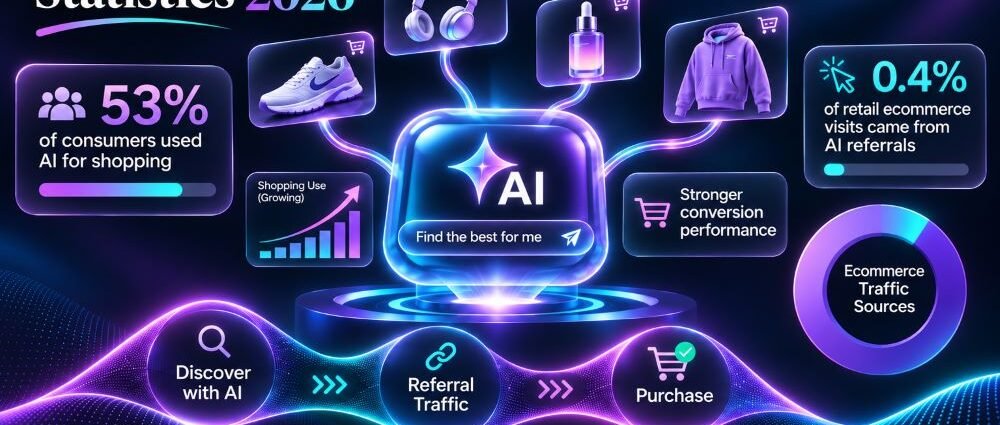
More than half of consumers in 11 surveyed markets have used AI for shopping, yet generative AI referrals account for just 0.4% of retail ecommerce visits. Those figures describe different behaviors, not consecutive stages of the same shopping journey. AI is already part of the shopping journey for millions of consumers, but its contribution to measurable ecommerce traffic remains surprisingly small.
Conversion data tells a more complicated story. Some retailers report stronger purchase rates from AI visitors, while others find weaker mobile performance or smaller orders. These AI shopping statistics for 2026 examine where AI enters the buying journey, which results are measurable, and what the findings mean for ecommerce marketers.
AI Shopping Statistics 2026 at a Glance
The latest research offers benchmarks for consumer adoption, referral traffic, conversion performance, and purchasing behavior. Each describes a different part of the shopping journey.
| Statistic | 2026 finding | Source |
|---|---|---|
| Consumers using AI for shopping | 53% across 11 markets | McKinsey |
| U.S. consumers using AI for shopping | 48% | McKinsey |
| Growth in generative AI ecommerce referrals | 203% YoY | Similarweb |
| AI referrals as a share of retail ecommerce visits | 0.4% | Similarweb |
| Growth in U.S. retail AI traffic | 71% YoY in September | Adobe |
| AI referral conversion advantage | 90% higher than non-AI traffic | Adobe |
| AI referral revenue per visit | 83% higher than non-AI traffic | Adobe |
| Share of identified AI referrals from ChatGPT | 88.1% across 73 stores | Shero |
| AI users reporting an AI-completed purchase | 14% across 11 markets | McKinsey |
Table 1. Selected 2026 findings from studies with different methodologies.
How Many Consumers Use AI for Shopping in 2026?
According to McKinsey’s 2026 research on AI shopping behavior, 53% of consumers across 11 markets used an AI chat tool, search service, or retailer assistant for at least one shopping task during the previous three months. The U.S. figure was 48%.
Published in October, the research drew on a June survey of approximately 21,000 people. Its headline adoption statistic used a weighted base of 9,988 respondents.
The definition of AI shopping is broad. Asking ChatGPT to compare cameras or suggest a birthday gift counts as usage, even if the shopper eventually buys through Google, Amazon, or a physical store. Adoption figures therefore say little about the proportion of sales generated directly by AI platforms.
Still, the role of AI extends beyond casual experimentation. Nearly one-third of AI shoppers in McKinsey’s survey identified AI chat or search as the biggest influence on their most recent purchase. A retailer might win or lose consideration before the customer opens a conventional search result.
AI Shopping Adoption by Age and Market
Younger consumers lead AI shopping adoption, although the differences are not uniform across countries. McKinsey found that 62% of Gen Z adults and 63% of millennials across its surveyed markets had used AI for shopping, compared with the overall 53% average. In the United States, Gen Z adoption reached 57%.
China and India showed particularly strong usage, supported by different AI ecosystems and shopping habits. These geographic differences matter for international retailers: a global adoption percentage may poorly represent the customers in an individual market.
Frequent use does not necessarily indicate greater confidence in the technology. Across the surveyed markets, 67% of Gen Z AI users said they trusted AI chat and search tools, compared with 73% of AI users overall.
Product category adds another consideration. An electronics buyer may ask AI to compare technical specifications, while someone shopping for clothing might request outfit suggestions or sizing advice. Both count as AI-assisted shopping, but the amount of research and the willingness to delegate decisions can differ substantially.
Similarweb’s State of Ecommerce 2026 reports that generative AI referrals increased 203% year over year. Despite that growth, AI platforms generated only 0.4% of retail ecommerce visits. The first statistic describes how quickly a channel is expanding; the second indicates its current scale relative to established acquisition sources.
Adobe independently recorded a 71% year-over-year increase in AI-referred visits to U.S. retail sites in September. Shero, however, found that daily AI referrals to its selected stores barely changed between September 2025 and September 2026, even as AI-attributed orders increased sharply.
The contrast illustrates why industry-level growth should not become an automatic traffic forecast for an individual store. Retailer size, platform mix, product category, and measurement methods all affect the result.
Traditional search also remains part of AI-assisted shopping. Similarweb reported that consumers using AI for product research also used search 89% of the time. The Google AI Mode shopping statistics show how conversational product discovery is also evolving within Google’s search environment.
Someone might shortlist products through AI and later reach a retailer through organic search or direct navigation. Conventional referral reporting can capture the final visit without preserving every earlier influence.
AI Shopping Conversion Rates Compared With Traditional Search
The strongest conversion figures come from Adobe’s October 2026 analysis of AI-referred retail traffic. In September, AI-referred visitors converted 90% better than non-AI traffic and generated 83% more revenue per visit. These are relative performance differences, not absolute conversion rates. Adobe’s broader analysis draws on transaction data covering more than one trillion U.S. retail visits.
Shopify found a similar advantage in Q1 2026, but within a narrower comparison. Among sessions beginning on product detail pages, AI-referred visitors converted 49% better than organic-search visitors. Orders attributed to AI search also had 14% higher average order values.
Why Product-Page Landings Matter
Landing-page behavior may explain part of the reported conversion advantage. Approximately 55% of Shopify’s AI-referred sessions began on product pages, compared with around 20% of organic-search sessions. A shopper who has already evaluated specific products with an assistant may arrive closer to making a decision.
That creates a problem when comparing channels without considering where visitors enter. Organic search might bring someone to an informational article, while an AI referral sends another shopper directly to a product they already intend to buy. A higher conversion rate in the second group does not necessarily mean the referral source itself caused the difference.
Why Conversion Studies Report Different Results
Not all datasets show a consistent advantage for AI traffic. Shero examined approximately 96 million sessions and 977,000 orders across 73 online stores. Among stores with sufficient AI traffic, the median AI conversion advantage over Google organic traffic was 25%, with 23% more revenue per visit. Yet AI orders were 15% smaller at the median store.
CHEQ found an even sharper difference by device. Across 14 retailers studied between August and October 2026, AI-referred visitors converted at 3.9% on desktop, versus 1.6% for human desktop visitors. On mobile, the relationship reversed: AI-referred conversion was only 0.6%, compared with 1.7% for human visitors.
Adobe covers a large U.S. retail dataset, Shopify isolates particular landing pages, Shero examines selected client stores, and CHEQ uses a smaller international sample. The studies demonstrate that AI traffic can be valuable, but its conversion advantage is not universal. For marketers, the more useful comparison is between equivalent visitor groups on their own websites, accounting for device, entry page, and product category.
Which AI Shopping Platforms Drive Retail Traffic?
ChatGPT generated 88.1% of identified AI assistant referrals in Shero’s study of 73 ecommerce stores. Gemini accounted for 5.1%, Perplexity for 3.7%, Copilot for 1.9%, and Claude for 1.2%.
This distribution offers a useful starting point for retailers investigating AI-driven product discovery, but it does not represent global ecommerce traffic. The study covers Shero’s selected merchant portfolio.
McKinsey also identified ChatGPT and Gemini among the most widely used standalone AI shopping tools in its surveyed markets outside China. Retailer-operated assistants remain relevant, especially as customers approach checkout and need inventory, delivery, or payment information.
Referral volume also has limitations as a measure of influence. An assistant may recommend a brand without generating an immediate website visit, and a shopper can later arrive through search, a marketplace, or direct navigation. Retailers should therefore distinguish visibility inside AI recommendations from the traffic and sales they can actually attribute.
AI-Assisted Shopping vs Purchases Completed by AI Agents
Researching a product with AI is not equivalent to allowing an agent to complete a transaction. McKinsey found that 14% of AI users across 11 markets reported completing a purchase with an AI tool, corresponding to approximately 9% of the overall surveyed population. Among U.S. AI users, the average share reporting an AI-completed purchase across comparable categories increased from 10% to 17% year over year.
Apparel, footwear, and accessories led the U.S. category breakdown at 18% of AI users. Other categories showed lower adoption, with reported purchasing ranging from 7% to 18%.
What Counts as an AI-Completed Purchase?
These are self-reported experiences rather than verified shares of retail transactions. They also should not be interpreted as evidence that every purchase happened autonomously without customer involvement.
Some assistants compare options or prepare a cart, leaving the shopper to approve payment. Others can perform more of the transaction. Retailer-operated assistants may help with checkout even when the final order passes through the merchant’s conventional payment system.
That distinction is essential when interpreting agentic commerce statistics. A customer accepting product advice is not delegating the same level of control as someone authorizing an AI agent to place an order.
Why Consumer Trust Still Limits Autonomous Shopping
Consumers appear more comfortable using AI for research than surrendering final purchasing authority. In a January 2026 survey of 322 U.S. consumers, Gartner found that 31% were willing to let AI narrow household-supply choices, while 28% would allow it to do so for personal electronics. Willingness to let AI make purchase decisions reached only 11%, even in lower-stakes categories.
Information quality creates another barrier. In separate Gartner research conducted in late 2025, 54% of consumers who had used AI for a recent shopping task said they needed to verify all the information provided. Another 62% reported that some AI-generated information had wasted their time.
These concerns are practical rather than abstract. Incorrect compatibility details, outdated prices, or misleading delivery information can make AI recommendations less useful than a conventional product search. Retailers may get more immediate value from accurate product comparisons and reliable checkout assistance than from fully autonomous purchasing.
Consumers can appreciate AI recommendations while still wanting control over the final decision. That balance between convenience and control will influence which shopping tasks they are willing to delegate.
What the AI Shopping Studies Actually Measure
Differences in methodology explain why impressive statistics sometimes appear inconsistent. The studies draw on consumer surveys, ecommerce analytics, and observed transaction data, each capturing a different aspect of shopping behavior.
| Study | Evidence | Important limitation |
|---|---|---|
| McKinsey | Consumer survey across 11 markets | Self-reported adoption and purchases |
| Similarweb | Ecommerce traffic and shopping journeys | AI influence extends beyond tracked referrals |
| Adobe | U.S. retail visits and transactions | Relative performance does not prove causation |
| Shopify | Merchant traffic and product-page sessions | Platform and landing-page selection |
| Shero | GA4 data from 73 online stores | Selected client sample |
| CHEQ | Device-level data from 14 retailers | Limited retailer and geographic coverage |
| Gartner | U.S. consumer attitude surveys | Willingness differs from completed behavior |
Table 2. Research methods and limitations of the cited studies.
Even when two studies report higher conversion rates from AI traffic, they may be comparing different visitors. An AI user arriving directly on a product page cannot automatically be equated with an organic visitor entering through a broader category or informational page.
Attribution has further limitations, and similar measurement gaps exist in Google Search. The limits of Search Console’s AI reporting illustrate why search visibility data cannot be treated as a direct measure of commercial results.
What AI Shopping Statistics Mean for Ecommerce Marketers
The 2026 findings support a measured approach to AI shopping rather than an immediate shift away from established acquisition channels. Start by separating identifiable AI referrals from other traffic, then compare their performance by device, product category, and landing page. CHEQ’s mobile results show why a promising desktop conversion rate may conceal significant friction elsewhere.
Product information deserves equal attention. Accurate specifications, compatibility details, availability, shipping costs, and return terms help shoppers evaluate recommendations and reduce uncertainty before checkout. When assistants direct visitors to specific products, the quality of those landing pages becomes especially important.
Order value matters alongside conversion. Shero’s findings suggest that AI visitors can purchase more frequently while placing smaller orders. Bundles, related products, and clear shipping thresholds may improve basket size, but retailers should test these changes rather than assume the same pattern applies everywhere.
Finally, treat AI as an additional influence in the purchase journey rather than an isolated replacement for search. Broader AI marketing adoption benchmarks place this shift alongside changes in advertising, search, and marketing measurement.
AI shopping is changing product discovery faster than it is changing measurable ecommerce traffic. For retailers, the immediate challenge is not to predict when autonomous shopping will dominate, but to understand which AI-assisted interactions lead to better product decisions and completed orders. That requires reliable product information, realistic attribution, and conversion analysis that goes beyond headline growth rates.