
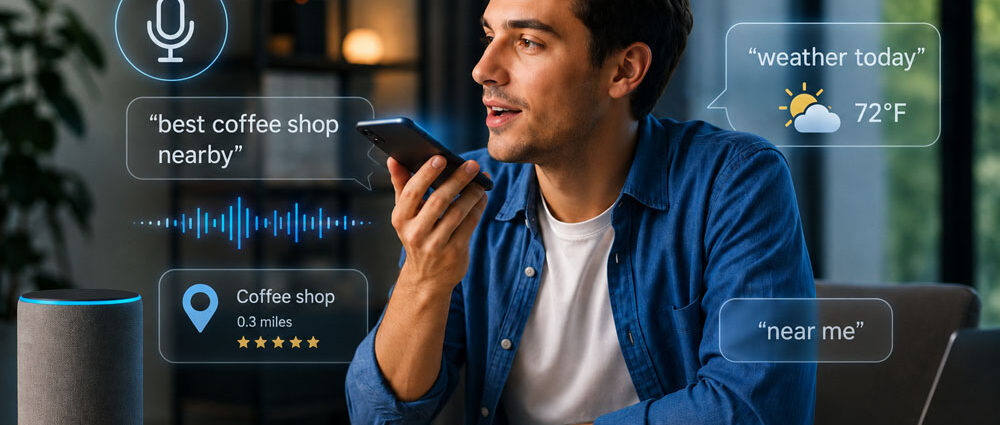
Voice search statistics in 2026 tell a more interesting story than “people talk to devices now.” Voice search is still widely used, but the hype has changed. People are not replacing every typed search with voice. Instead, they use voice search when it is faster, hands-free, local, or connected to a task they want done quickly.
That shift matters for SEO, content, and business strategy. A local customer may ask Siri for the nearest repair service. A driver may ask Google for directions. Someone cooking may ask Alexa to set a timer or reorder a household item. A mobile user may ask a quick question instead of typing it. These are all different from traditional search, but they still depend on clear information, trusted sources, and useful answers.
This report looks at the voice search statistics that matter most in 2026, the major assistant ecosystems, the future of voice search, and what businesses can actually do with the data.
Voice Search Statistics 2026 That Matter Beyond The Hype
Here are the voice search statistics worth paying attention to before getting into the details.
| Voice Search Data Point | Latest Snapshot | Why It Matters |
|---|---|---|
| Worldwide weekly voice assistant use | 22.5% of internet users age 16+ in Q4 2025 | Voice assistants remain mainstream, but not universal |
| US weekly voice assistant use | 28.8% of internet users age 16+ in Q4 2025 | US usage sits above the worldwide average |
| US voice assistant users | Around 157.1 million projected for 2026 | The US remains one of the largest voice assistant markets |
| US smart speaker ownership | 35% of Americans age 16+ in 2025 | Ownership is widespread, but growth has largely plateaued |
These figures come from different datasets rather than one universal “voice search in 2026” study. Recent worldwide voice assistant data puts weekly usage at 22.5% of internet users globally and 28.8% in the United States in Q4 2025. Separate forecasts put the US voice assistant audience at roughly 157.1 million in 2026, so population, frequency, and methodology all matter when comparing voice statistics.
What Percentage Of People Use Voice Search?
A recent global benchmark found that 22.5% of internet users age 16 and older used voice assistants weekly in Q4 2025. That does not mean 22.5% of all searches are spoken. It measures the share of internet users who use voice assistants, not the share of total search queries conducted by voice.
This is where many older voice search predictions went too far. Voice search grew quickly because smartphones, smart speakers, cars, and home devices made it easy to talk to technology. But people still prefer typing when they want privacy, visual comparison, product research, detailed reading, or control over complex searches.
So the better takeaway is that voice search is not replacing typed search. It is becoming part of a larger search behavior mix, increasingly overlapping with AI assistants and conversational interfaces.
Voice Search Growth Is Real But Slower Than The Hype
Voice search growth is real, but it is not the explosive takeover many early articles predicted. The market has matured. People know when voice is useful, and they also know when typing or tapping is better.
Smart speaker ownership shows that maturity clearly. Edison Research found that US smart speaker ownership increased only from 33% in 2021 to 35% in 2025 among people age 16 and older. The installed base is substantial, but device adoption has largely plateaued instead of continuing its earlier rapid expansion.
Voice search works best for:
- Quick facts
- Local searches
- Directions
- Calls
- Timers and reminders
- Weather
- Music
- Smart home controls
- Repeat shopping tasks
- Hands-free mobile searches
It works less well when the user wants to compare prices, read reviews, inspect charts, choose between many options, or make a sensitive search in public. That is why voice search growth should be understood as selective adoption, not total replacement.
Voice Search Trends Shaping 2026
Voice search trends in 2026 are tied closely to AI, mobile behavior, local search, and the way assistants are becoming more conversational. The biggest change is that voice search is moving away from simple commands and toward assistant-led tasks.
AI Assistants Are Changing Voice Search
One of the biggest voice search developments is the shift from old-style voice assistants to AI-powered assistants. Instead of asking one short question and getting one short answer, users increasingly expect assistants to understand context, remember preferences, and complete multi-step tasks.
Alexa+ shows where voice assistants are heading: more conversational, more capable, more personalized, and more focused on getting tasks done. That is a different experience from the older “ask a command, get a short reply” model.
This matters for businesses because future voice search may not always look like a search result. It may look like an assistant making a recommendation, completing a booking, summarizing options, or pulling information from several sources at once. The same broader shift is visible in search itself, where Google AI Mode statistics help illustrate how conversational AI experiences are moving closer to traditional search behavior.
Local Voice Search Still Drives Real-World Actions
Local voice search remains one of the strongest practical use cases. People ask for restaurants, stores, repair services, directions, opening hours, and “near me” results when they need something quickly.
A typical query might be:
“Hey Google, find an emergency plumber near me.”
For local businesses, this means voice search ranking is closely connected to local SEO basics: accurate business information, strong reviews, service pages, location signals, and clear answers to common questions.
Voice search does not remove the need for local SEO. It makes the basics even more important.
Mobile Voice Search Remains Useful For Hands-Free Tasks
Mobile voice search is still practical because people often use it when typing is inconvenient. Someone may be driving, walking, cooking, shopping, working, or multitasking. In those moments, voice feels natural because it saves effort.
These users usually want fast answers, not long explanations. For SEO, that means clear formatting matters. Pages should answer obvious questions quickly, then provide more detail for readers who want it.
Voice Search Is Becoming More Task-Based
The future of voice search is less about asking “What is the answer?” and more about asking “Can you do this for me?”
Examples include:
- Book a ride
- Add an item to a shopping list
- Turn off lights
- Summarize a message
- Find a nearby store
- Reorder a product
- Start a playlist
- Set a meeting reminder
This makes voice search more connected to AI assistants, apps, smart home systems, commerce platforms, and personal workflows. Businesses should think beyond rankings alone and ask whether their information, products, and services can be found and acted on through assistant-driven experiences.
Which Voice Assistants Matter Most In 2026?
The most relevant voice assistant ecosystems now extend well beyond the original smart-speaker category. Important platforms and interfaces include:
- Google voice experiences, Gemini, and Gemini Live
- Apple Siri
- Amazon Alexa and Alexa+
- ChatGPT Voice
- Microsoft Copilot Voice and Windows voice experiences
- Samsung Bixby
The importance of each assistant depends on the device and task. Siri remains closely tied to Apple’s mobile ecosystem, Alexa is strong in smart-home use, and Google’s voice interfaces increasingly overlap with Gemini. ChatGPT Voice and Microsoft Copilot extend the category further into conversational research, productivity, and work tasks.
That is why “voice platform” means something broader in 2026 than it did a few years ago. Voice is becoming an interface inside larger AI, search, operating-system, and smart-device ecosystems rather than a category defined mainly by smart speakers.
How Many People Use Siri?
An earlier EMARKETER estimate put Siri at about 86.5 million US users in 2025. That figure is useful for understanding the scale of Siri’s audience, but it should not be presented as a verified 2026 user count.
Even when people do not think of themselves as “voice search users,” they may use Siri for calls, directions, reminders, quick facts, messages, or hands-free tasks. Its importance comes largely from its integration across iPhones and the wider Apple device ecosystem.
Why Has Voice Search Stopped Growing So Fast?
Voice search has not stopped. What has stopped is the idea that voice would quickly replace typing.
There are a few reasons growth feels slower:
- People prefer screens for complex searches.
- Public voice searches can feel awkward or private.
- Shopping comparisons usually work better visually.
- Voice assistants still misunderstand some queries.
- Many users use voice for tasks, not open-ended research.
- AI chat has shifted attention away from older voice assistants.
This does not mean voice search is dead. It means voice search has found a more specific role: fast, hands-free, local, and task-based interactions, while typed and visual search remain better suited to deeper research and comparison.
What Is The Future Of Voice Search?
The future of voice search is likely tied to AI assistants, not traditional command-based search. People will still ask quick questions, but the bigger shift is toward assistants that can understand context and complete tasks.
Voice search predictions for the next few years should be practical:
- Voice will stay strong for local and hands-free searches.
- AI assistants will make voice more conversational.
- Smart speakers will focus more on tasks and home control.
- Complex research will still rely heavily on screens.
- SEO will overlap more with AI answer optimization.
- Brands will need clearer structured information across platforms.
The future of voice search is not “everyone stops typing.” It is voice becoming one more way people interact with AI, search, devices, and services.
Voice Search Platforms Compared
Different assistants matter for different user behaviors, and several now operate across more than one device category.
| Platform | Common Use Case | Business Takeaway |
|---|---|---|
| Google voice experiences / Gemini | Local search, directions, conversational answers, mobile tasks | Clear answers, local SEO, and structured information matter |
| Siri | iPhone tasks, directions, messages, calls, quick facts | US mobile visibility and accurate local data matter |
| Alexa / Alexa+ | Smart home, shopping lists, music, timers, repeat purchases | Useful for home tasks, simple commerce, and assistant-led actions |
| ChatGPT Voice | Conversational questions, research, explanations, multi-turn tasks | Clear, authoritative information matters beyond traditional search results |
| Microsoft Copilot Voice | Productivity, workplace search, documents, AI assistance | More relevant for B2B and work contexts |
| Samsung Bixby | Samsung device controls and mobile assistance | Most relevant inside the Samsung ecosystem |
The main point is simple: businesses should not think about one generic voice search user. Someone asking Alexa to reorder an item at home behaves differently from someone asking Google for a nearby service, using Siri while driving, or holding a longer conversation with an AI assistant.
Voice Search Ranking And SEO Signals
Voice search ranking is not a separate magic formula. It usually depends on the same foundations that help regular search, local SEO, and answer-based content.
The most important signals include:
- Clear, concise answers
- Strong page relevance
- Mobile-friendly pages
- Fast loading speed
- Structured headings
- Local SEO signals
- Google Business Profile accuracy
- Reviews and location trust
- Schema markup where useful
- Content that answers natural questions
Voice queries often sound more conversational than typed searches. Someone might type “voice search stats 2026,” but ask, “How many people use voice search?” That is why question-style sections can help, as long as they answer directly and do not feel stuffed.
For local businesses, voice search ranking often depends on whether the business information is complete, consistent, and trusted.
Voice Search Analytics And Google Analytics Tracking
Voice search analytics are tricky because analytics tools do not always label traffic as “voice search.” In GA4, there is no simple default report that says, “These visitors came from voice.”
That makes voice search Google Analytics tracking indirect. Businesses usually need to look at clues from several places:
- Google Search Console question queries
- Long-tail conversational searches
- “Near me” and local-intent queries
- Google Business Profile calls and direction requests
- Call tracking
- Landing page behavior
- UTM-tagged campaigns
- Search terms from paid campaigns
- Support and sales call patterns
This does not give a perfect voice search report, but it helps a business understand whether voice-style behavior is influencing discovery and conversions. Measurement becomes even less clean when voice interactions lead into AI-generated search experiences; Google Search Console AI reporting presents a related attribution problem because newer AI-driven search behavior is not always isolated as a separate organic channel.
Can You Track Voice Search In Google Analytics?
Not directly in a clean, automatic way. Google Analytics does not normally label organic traffic as voice search by default.
The better approach is to combine GA4 with Search Console, local SEO data, call tracking, and query analysis. Look for conversational phrases, question-based searches, local-intent patterns, and pages that receive traffic from long-tail questions.
For example, a business might not see “voice search” as a channel. But it may see growth in queries like “best dentist near me open now,” “how much does emergency plumbing cost,” or “where can I buy running shoes nearby.” Those are the kinds of searches that often overlap with voice behavior.
Real-World Examples Of Voice Search
Voice search becomes easier to understand when you look at real situations. The point is not that every search will become voice-first. Voice works especially well when the user needs a fast, hands-free, local, or repeat-action answer.
Local Voice Search For Urgent Services
A homeowner says:
“Hey Google, find an HVAC repair company near me.”
The search engine may rely on business listings, reviews, location, service pages, and availability. A local company with weak listings or poor reviews may lose even if its website looks good.
Voice Search For Repeat Ecommerce Purchases
A customer says:
“Alexa, reorder laundry detergent.”
This is not a deep research query. It is a repeat-purchase task. Voice commerce tends to work best when the decision is simple and the user already trusts the product.
Mobile Voice Search While Driving
A driver says:
“Siri, find a gas station on my route.”
This is where voice search is clearly useful: hands-free, local, and immediate. The user is not browsing a long article. They want an answer now.
B2B Voice Search And AI Assistant Queries
A manager asks:
“What is the best CRM for a small sales team?”
This kind of query may blend voice search, AI assistants, and answer-engine behavior. The assistant may summarize options instead of showing a traditional list of links, which makes clear comparison content more important.
Voice Search Predictions For Businesses
Voice search predictions should be realistic. The next stage will not be about every user speaking every search. It will be about voice becoming more useful inside AI-powered workflows.
Businesses should expect:
- More conversational assistant responses
- More local and task-based voice behavior
- More AI-generated summaries from voice platforms
- Continued importance of local SEO
- More overlap between voice search, AI search, and answer-engine optimization
- Stronger demand for clear product, service, and business data
- More pressure to make content easy to extract and summarize
This means voice search news should be watched through the lens of AI assistants. Alexa+, Siri, Google Gemini experiences, ChatGPT Voice, and Microsoft Copilot all point toward a future where search, tasks, and assistant behavior are harder to separate.
How Businesses Should Prepare For Voice Search
The practical response is straightforward: companies do not need a separate “voice search website.” They need clearer content, stronger local data, and better answers that work across search and assistant-driven experiences.
Start with these steps:
- Answer common customer questions clearly.
- Create pages for high-intent local and service queries.
- Keep Google Business Profile information accurate.
- Improve page speed and mobile experience.
- Use natural language in headings where it helps.
- Add schema markup for FAQs, local business details, products, or services when relevant.
- Track calls, direction requests, and local actions.
- Monitor Search Console for question-based queries.
- Write concise answer sections before deeper explanations.
- Keep business information consistent across platforms.
Voice search works best when search systems can understand what the business does, where it operates, who it serves, and why the answer is trustworthy. The same foundation becomes more useful as voice interfaces increasingly feed into broader AI-assisted search and task completion.
Final Takeaway On Voice Search Statistics
Voice search statistics show that voice remains important, but the story is more nuanced than early predictions suggested. In Q4 2025, 22.5% of internet users age 16+ worldwide used voice assistants weekly, compared with 28.8% in the United States, while the US voice assistant audience is projected at roughly 157.1 million in 2026.
At the same time, smart speaker ownership in the United States has barely moved from roughly one-third of the population over the past several years. That helps explain the broader pattern: voice has not disappeared, but hardware adoption has matured while the technology itself is moving deeper into mobile devices, AI assistants, local search, and hands-free tasks.
The smartest way to use voice search data is not to chase hype. It is to make business information clearer, answer real questions directly, improve local visibility, and prepare for a search environment where voice assistants and AI search keep moving closer together.