
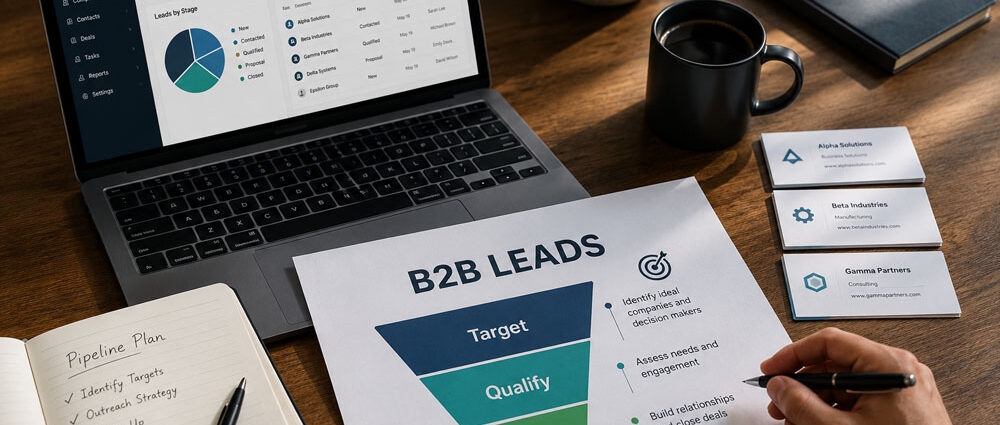
B2B leads are not just names in a spreadsheet. They are companies, buyers, and decision-makers that may have a real reason to buy from your business. The hard part is not getting more contacts; it is finding the right people, understanding their intent, and giving sales enough context to start a useful conversation.
That is why modern B2B lead generation has moved beyond “collect emails and follow up.” A strong system now needs research, targeting, content, outreach, qualification, tracking, and nurturing. Good B2B sales leads rarely come from one tactic alone; they usually come from a connected process that helps the right buyers find you, trust you, and take the next step.
This guide explains what B2B leads are, how to generate them in 2026, how to qualify them, and how to build a B2B lead generation strategy around quality instead of empty volume. The goal is a system that creates useful sales opportunities rather than a larger contact database.
What B2B Leads Mean And Why Quality Matters
B2B leads are potential customers for a company that sells products or services to other businesses. A B2B lead can be a person, a company, or a target account that shows some level of interest or fit.
Examples of B2B leads include:
- A founder who books a demo
- A marketing manager who downloads a guide
- A company that visits your pricing page several times
- A procurement team that requests a quote
- A LinkedIn prospect who replies to outreach
- A target account that matches your ideal customer profile
The important point is that not every B2B lead is equal. A student downloading a white paper, a competitor checking your content, and a VP asking for pricing should not be treated the same way.
That is where many businesses go wrong. They celebrate lead volume before checking lead quality. A smaller list of qualified prospects is often more valuable than a large database full of people who will never buy.
B2B Lead Generation Statistics Worth Knowing
Current buyer behavior helps explain why B2B lead generation cannot stop at collecting form fills. The strongest signals in 2026 are about self-directed research, AI-assisted discovery, multiple information sources, and the point where human sales input becomes useful. Lead generation therefore has to support both independent research and the later moments when a buyer wants human validation.
| Buyer Signal | What It Means For B2B Lead Generation |
|---|---|
| 67% of B2B buyers prefer a rep-free experience | Content and self-service information need to help buyers research before they talk to sales |
| 45% used GenAI during a recent B2B purchase | Vendor discovery and research increasingly happen through AI-assisted workflows as well as traditional search |
| Buyers used an average of seven information sources during a recent purchase | One landing page or one outreach message rarely carries the whole buying journey |
| 69% prefer to validate AI-generated insights with sales reps | Sales still matters, but often later as a source of validation, context, and confidence |
Gartner’s May 2026 B2B buyer survey reported these patterns from 645 B2B buyers surveyed in August and September 2025. The picture is not “buyers no longer want sales”; it is that they increasingly research independently and bring sellers in when they need validation, context, or help moving a decision forward.
How To Generate B2B Leads In 2026
There is no single best channel for every company. The best way to get B2B leads is usually a mix of inbound, outbound, paid, and nurture. The right blend depends on your product, market, deal size, sales cycle, and buyer awareness.
Start With A Clear ICP
Before trying to generate B2B leads, define who should become a lead in the first place. Your ideal customer profile, or ICP, should describe the companies most likely to buy, benefit, and stay. It should be specific enough to guide targeting without excluding good prospects for arbitrary reasons.
A useful ICP includes:
- Industry
- Company size
- Location
- Revenue range
- Tech stack
- Pain points
- Buying triggers
- Decision-makers
- Budget range
- Sales cycle length
Without a clear ICP, B2B lead generation becomes messy. Campaigns may produce contacts, but sales will struggle to turn them into pipeline.
Build A B2B Lead Generation Funnel
A B2B lead generation funnel helps you understand where each prospect is in the buying journey. It also prevents marketing and sales from treating every contact as if they were ready for the same next step. The useful distinction is not just who converted, but what the buyer is ready to do next.
| Funnel Stage | What The Buyer Is Doing | Useful Lead Generation Activity |
|---|---|---|
| Awareness | Realizing there is a problem | SEO articles, LinkedIn posts, industry reports |
| Research | Comparing possible solutions | Guides, webinars, checklists, comparison pages |
| Evaluation | Looking at vendors | Case studies, demos, pricing pages, ROI tools |
| Sales-ready | Taking direct action | Demo requests, quote forms, consultation calls |
| Nurture | Not ready yet, but still relevant | Email sequences, retargeting, remarketing, newsletters |
This is where many companies lose leads. They treat everyone as sales-ready. In reality, some people need a demo now, while others need education, proof, or follow-up before they are ready to talk.
Use SEO To Capture High-Intent Buyers
SEO can generate B2B leads by capturing people who are already searching for answers, comparisons, pricing information, or solutions to a defined problem. In 2026, that visibility also extends into AI-assisted research, where clear product, use-case, comparison, and proof content can influence how buyers discover and evaluate vendors.
Strong B2B SEO topics include:
- Problem-aware guides
- Industry-specific service pages
- Software comparison pages
- Cost and pricing explainers
- “Best tools” or “best providers” pages
- Case studies
- Integration pages
- Use-case pages
For example, a cybersecurity company may create content around “best endpoint protection for small businesses” or “how to reduce phishing risk for remote teams.” These searches show more intent than broad awareness topics. SEO takes time, but it can produce a steady source of qualified B2B leads when the content matches real buyer questions.
Use LinkedIn For Targeted B2B Lead Generation
LinkedIn is useful because B2B targeting often depends on job title, industry, company size, seniority, and account lists. Its lead generation resources also emphasize professional targeting and measurement, which makes the platform useful when a campaign needs to reach specific roles or accounts rather than a broad consumer audience. That precision is most valuable when the offer and message are tailored to the role being targeted.
LinkedIn can support:
- Organic thought leadership
- Founder-led content
- Sales outreach
- Account-based marketing
- Sponsored content
- Retargeting
- Event promotion
- Lead magnet campaigns
The mistake is using LinkedIn only for cold pitching. Better results usually come from mixing useful content, soft engagement, direct outreach, and proof. A sales leader is more likely to respond when the message feels relevant to their role and problem, not like a mass template.
Use Email For B2B Outbound Lead Generation
B2B outbound lead generation still works when it is targeted, researched, and respectful. It fails when companies blast generic messages to scraped lists. Relevance has to come from the account, role, trigger, or problem rather than a token personalized first line.
Good outbound starts with:
- A specific buyer segment
- A real pain point
- Clean contact data
- A relevant reason for reaching out
- A short message
- A low-pressure next step
- Follow-up that adds value
For example, a marketing agency should not send the same email to every CEO. A better approach is to segment SaaS founders, ecommerce brands, and professional service firms separately, then write outreach that reflects their actual business problem. The principle is simple: reach the right buyers with a message that proves you understand their situation.
Use Paid Ads To Capture Existing Demand
Paid search, LinkedIn Ads, and retargeting can help generate B2B sales leads faster than SEO alone. The key is to match the channel to the buyer’s intent and judge performance by qualified outcomes rather than raw form volume. A campaign that produces fewer but sales-accepted leads can be more useful than one that wins on CPL alone.
Paid search works well when buyers already know what they need. LinkedIn Ads work well when you need to reach a specific audience before they search. Retargeting works well when people visited your website but did not convert.
Useful paid campaigns include:
- Google Ads for high-intent keywords
- LinkedIn Ads for role-based targeting
- Retargeting for website visitors
- Competitor comparison campaigns
- Webinar promotion
- Demo or consultation offers
- Industry-specific landing pages
Paid ads should not be judged only by cost per lead. In B2B, a more expensive lead can still be better if it matches the ICP and has a real chance to become revenue. Companies that want outside help can compare B2B PPC agencies by their ability to connect paid media with qualification, CRM data, pipeline, and revenue.
Use Webinars, Events, And Partnerships
Not all B2B lead generation activities happen through search or outreach. Webinars, industry events, partner campaigns, podcasts, and referral programs can all create qualified conversations.
These channels work especially well when trust matters. A buyer may ignore a cold ad but attend a webinar hosted with a known partner, while a referral from a trusted vendor can shorten the sales cycle. A small event can generate fewer leads but better conversations, and partnerships can be especially useful with larger buyers that want confidence before entering the sales process.
Use Retargeting And Lead Nurturing
Many B2B buyers need more than one interaction before they are ready to talk to sales. They may read a blog post, compare vendors, talk internally, return weeks later, and then book a demo. Nurture exists to support that delay rather than treating every non-conversion as lost demand.
Salesforce’s guide to lead generation best practices describes lead scoring, automated follow-up, CRM tracking, and nurturing as parts of the lead-generation process. The practical point is that capturing the lead is only the first step; the system still has to decide who needs sales attention and who needs more time.
Good nurturing can include:
- Email sequences
- Retargeting ads
- Case studies
- Product education
- ROI guides
- Comparison pages
- Event invitations
- Sales follow-up based on behavior
Nurturing keeps the company visible while the buyer is still evaluating options. The goal is not to force an early sales conversation, but to remain useful until the buyer has enough intent and context for the next step.
Best Way To Get B2B Leads By Channel
There is no universal best way to get B2B leads. The best channel depends on how buyers search, how expensive the offer is, and how long the sales cycle takes.
| Channel | Best For | Weak Spot |
|---|---|---|
| SEO | Buyers already researching a problem | Takes time to build |
| Targeting roles, accounts, and industries | Can get expensive or noisy | |
| Cold email | Direct outreach to specific buyers | Needs strong data and personalization |
| Paid search | High-intent demand capture | Competitive keywords can cost more |
| Webinars | Education and trust-building | Needs strong follow-up |
| Partnerships | Warm introductions | Slower to scale |
| Retargeting | Staying visible to warm prospects | Needs existing traffic |
| Referrals | High-trust opportunities | Harder to control volume |
A healthy B2B lead generation funnel usually uses more than one channel. SEO may bring long-term demand, paid ads may capture buyers now, and LinkedIn or email may reach target accounts before they search. Nurture keeps people engaged until timing improves. For paid acquisition, B2B PPC benchmarks are most useful as reference points when they are read alongside lead quality and pipeline results.
How To Generate Leads For B2B Sales Teams
To generate leads for B2B sales, marketing should focus on fit, intent, and context. Sales teams do not just need a name and email. They need to know why the lead matters.
A useful B2B sales lead handoff should include:
- Company name
- Buyer role
- Industry
- Company size
- Pain point
- Source channel
- Content viewed
- Form submitted
- Urgency signal
- Suggested next step
For example, “downloaded our guide” is not enough. A better handoff would be: “VP of Operations at a 250-person logistics company viewed the pricing page twice, downloaded the warehouse automation checklist, and requested a workflow audit.” That gives sales a concrete reason to reach out and useful context for the first conversation.
How To Qualify B2B Leads Before Sales Outreach
Lead qualification is one of the most important parts of the process because it separates response volume from sales relevance. Qualification protects the sales team from wasting time on poor-fit contacts and gives marketing a clearer feedback signal. The criteria should reflect the actual buying process rather than a generic scoring template.
A simple qualification checklist:
| Qualification Factor | Question To Ask |
|---|---|
| Company fit | Does the company match the ICP? |
| Role fit | Is the person a decision-maker, influencer, or researcher? |
| Problem fit | Does the lead have a problem the business can solve? |
| Urgency | Is the need active now or only future interest? |
| Budget | Can the company likely afford the solution? |
| Authority | Can this person influence the buying process? |
| Engagement | Did the lead take a meaningful action? |
| Sales readiness | Is this lead ready for outreach now? |
Not every lead should go directly to sales. Some should enter nurture, be disqualified, or receive more research before outreach. This is how companies improve quality instead of just increasing volume, and why comparing cost per lead with cost per qualified lead can be more useful than looking at CPL alone.
B2B Lead Generation Examples By Business Model
Different business models need different lead-generation systems. The examples below are illustrative scenarios, not documented client case studies. They show how channel mix, intent, and qualification can change across SaaS, services, industrial sales, and enterprise accounts.
How A SaaS Company Can Generate B2B Leads Online
A project management SaaS company wants more demos from agencies. It creates comparison pages, runs Google Ads for high-intent terms, retargets visitors on LinkedIn, and sends nurture emails based on company size.
Why it works:
- SEO captures buyers already researching.
- Paid search captures demand.
- Retargeting brings warm visitors back.
- Email nurtures prospects before the demo.
This approach gives each channel a different job instead of asking one source to carry the entire funnel. It also reduces dependence on any single acquisition channel.
Lead Generation For B2B Service Companies
An accounting firm wants more business clients. It publishes pages like “bookkeeping for construction companies,” runs LinkedIn outreach to finance managers, and offers a tax-readiness checklist.
Why it works:
- The niche is specific.
- The pain point is clear.
- The lead magnet is useful.
- Sales can qualify by company type and need.
This works better than generic lead generation because the message speaks to a specific buyer and problem. The same specificity also makes qualification easier for sales.
How To Generate B2B Sales Leads In Industrial Markets
A manufacturer wants distributor leads. It creates product-spec pages, quote-request forms, and paid search campaigns around high-intent part numbers.
Why it works:
- Technical buyers search specifically.
- Quote requests show buying intent.
- Sales can prioritize by volume, location, and timeline.
This approach works when technical buyers already know what they need and search with specific commercial intent. Product details, part numbers, and quote requests give sales clearer signals for prioritization.
B2B Lead Generation For Enterprise Sales
A cybersecurity company targets 500 named accounts. It runs account-based ads, creates executive guides, hosts a webinar, and scores engagement before sales outreach.
Why it works:
- The company focuses on the right accounts.
- Content builds trust before the sales call.
- Engagement data helps sales prioritize.
- The strategy fits long buying cycles.
For enterprise teams, B2B lead generation is less about raw quantity and more about account fit. Engagement across several stakeholders can matter more than collecting a large number of isolated contacts.
B2B Lead Generation Best Practices
B2B lead generation best practices should improve the quality of sales conversations, not just increase form fills. The principles below keep targeting, qualification, and follow-up connected to the same revenue goal. They also make it easier to diagnose whether a problem sits in acquisition, qualification, nurture, or sales handoff.
Use these principles:
- Focus on the ICP first
A lead is only useful if the company and buyer match the market you serve. - Create offers for different funnel stages
A checklist, guide, demo, calculator, and consultation do not attract the same level of intent. - Track source and behavior
A lead from a pricing page is different from a lead from a broad blog post. - Connect marketing and sales feedback
Sales should tell marketing which leads were useful and which were not. - Use qualification rules
Define what makes a lead raw, MQL, SQL, or opportunity. - Personalize outreach by segment
Generic messaging weakens both inbound and outbound performance. - Nurture leads that are not ready
A “not now” lead can still become a customer later. - Measure pipeline, not just lead count
The real question is whether leads turn into sales opportunities and revenue.
Applied together, these practices help a company scale lead generation without filling the CRM with weak-fit contacts. They also give marketing and sales a shared definition of what progress actually looks like.
Common Mistakes That Hurt B2B Sales Leads
Many companies do not struggle because they lack tactics; they struggle because the tactics are disconnected. A channel can appear productive in isolation while sending weak-fit contacts into an overloaded sales process. The warning signs usually appear when marketing metrics look healthy but sales cannot turn the resulting leads into useful conversations.
Common mistakes include:
- Chasing lead volume instead of lead quality
- Sending every form fill to sales
- Using the same message for every industry
- Running ads without landing page testing
- Ignoring LinkedIn or email follow-up
- Not connecting CRM data to marketing
- Treating content as traffic, not lead generation
- Forgetting to nurture early-stage buyers
- Measuring only CPL instead of pipeline
- Using vague offers like “contact us” too early
The biggest mistake is assuming more leads automatically means more revenue. In B2B, more bad leads can make the sales team slower, not stronger.
How To Build A Simple B2B Lead Generation Strategy
A simple B2B lead generation strategy does not need to start with ten channels. It should start with a clear buyer, a clear offer, and enough tracking to show whether the resulting leads become useful sales conversations. Adding more channels before that feedback loop works usually creates complexity faster than it creates qualified demand.
A practical plan:
- Define your ICP
Choose the industries, company sizes, roles, and problems that matter most. - Pick one high-intent offer
This could be a demo, audit, checklist, consultation, quote, or calculator. - Build one strong landing page
Explain the problem, value, proof, and next step clearly. - Choose two traffic channels
For example, SEO and LinkedIn, or paid search and email outreach. - Add tracking
Use CRM fields, UTMs, form questions, and source data. - Qualify before handing off
Do not send every contact to sales without context. - Follow up with nurture
Build email or retargeting paths for leads that are not ready. - Review sales feedback every month
Ask which leads became real conversations and why.
This keeps the system manageable while the team learns what actually produces qualified demand. Once one channel and offer work, the business can add more lead-generation activities without losing the feedback loop that made the first combination successful.
B2B Lead Generation Questions Worth Answering
What Are B2B Leads?
B2B leads are people, companies, or target accounts that may become customers for a business selling to other businesses. They can come from forms, demos, events, outbound outreach, website visits, ads, or referrals.
How Do You Generate B2B Leads?
You generate B2B leads by defining the right buyers, creating useful offers, using channels like SEO, LinkedIn, email, paid ads, webinars, and referrals, then nurturing and qualifying prospects before sales outreach.
What Is The Best Way To Get B2B Leads?
The best way to get B2B leads is to combine inbound demand capture with targeted outbound and lead nurturing. SEO and content attract buyers already researching, while LinkedIn, email, and paid ads help reach specific accounts faster.
How To Generate Leads For B2B Sales?
To generate leads for B2B sales, focus on accounts that match your ICP, collect intent signals, and give sales enough context to start a useful conversation. A good lead handoff should include the buyer’s role, company fit, pain point, source, and next best action.
How To Qualify B2B Leads Before Sales Outreach?
To qualify B2B leads before sales outreach, check company fit, buyer role, urgency, budget, problem match, engagement level, and sales readiness. Not every form fill should go straight to sales; some leads need nurturing, while others should be disqualified.
How To Generate B2B Leads Online?
To generate B2B leads online, use SEO pages, landing pages, LinkedIn outreach, paid search, lead magnets, webinars, email campaigns, retargeting, and conversion-focused forms. The key is to connect every channel to a clear offer and follow-up process.
How Do You Generate More B2B Leads Without Lowering Quality?
To generate more B2B leads without lowering quality, improve targeting before increasing traffic. Then use clearer offers, better landing pages, stronger qualification rules, retargeting, and sales feedback loops to scale only the leads that match your business.
From B2B Leads To Real Sales Opportunities
B2B leads are useful only when they help the business move closer to real sales opportunities. A long list of weak contacts may look good in a report, but it will not help if sales cannot turn those contacts into conversations, pipeline, and revenue. The best approach is to build a complete system: define the right buyers, attract them through useful channels, qualify them carefully, and nurture them until they are ready for sales. That is the difference between simply generating B2B leads and building a lead generation engine that actually supports growth.