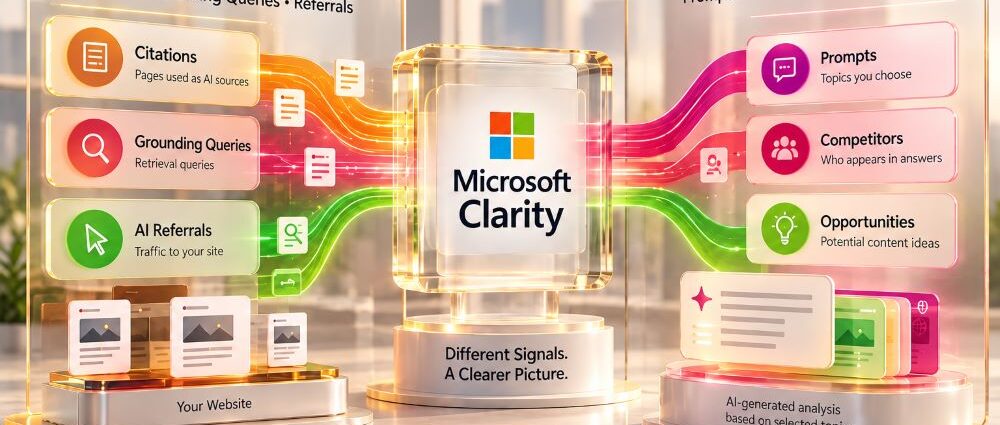
AI search visibility is difficult to measure because citations, referrals, prompts, and rankings are not the same thing. Microsoft Clarity AI Visibility separates several of those signals, but each metric needs to be read on its own terms.
The key distinction is between observed citation activity and research that Topic Insights generates. Citations, grounding queries, cited pages, and AI referral traffic describe activity Clarity has observed, while Topic Insights starts with topics and prompts selected for analysis and explores how a brand appears across that defined set. A citation count is not an AI ranking, a grounding query is not necessarily the user’s original prompt, and Share of Authority is not a universal measure of the entire AI search market.
What Microsoft Clarity AI Visibility Actually Measures
Microsoft Clarity AI Visibility combines several related reports rather than one universal score. Each one answers a different question, so marketers should not treat the numbers as interchangeable.
| Report or metric | Data type | Best use |
|---|---|---|
| Citations | Observed citation activity | See where site pages are used as AI sources |
| Grounding queries | Retrieval queries tied to citations | Understand how AI systems retrieve supporting content |
| Query Topics | Grouped grounding queries | Find themes already associated with citations |
| Share of Authority | Citation-share metric | Compare citation presence within Clarity’s measured set |
| Topic Insights | Topic and prompt-based analysis | Explore competitors, visibility gaps, and content opportunities |
| AI referral traffic | Sessions from AI assistants | Measure traffic that actually reaches the site |
A brand can have citations but little referral traffic, or perform well in Topic Insights without proving that real users are asking those exact prompts. Microsoft’s AI Citations documentation is useful here because several dashboard terms look familiar to SEO teams while working differently from traditional rankings and Search Console queries.
Microsoft Clarity AI Citations Show More Than Referral Traffic
AI referral analytics begin after a user clicks through to a website. Citation reporting looks earlier in the discovery process by showing pages AI systems used as sources, including cases where the user never visits the cited site. A page can influence an answer without winning the click, so marketers need to monitor citation visibility and website sessions as separate outcomes.
Grounding Queries Are Not User Search Queries
A grounding query may look like a keyword, but it describes retrieval rather than necessarily reproducing what the user typed or said. An AI system can take a longer conversational prompt, break it into smaller retrieval tasks, and search for supporting information with different wording.
The query Clarity shows can therefore help explain why the AI system retrieved a page without revealing the exact original prompt. Repeated grounding queries can still help with content analysis, but they are not a direct substitute for keyword research.
A Citation Count Is Not an AI Ranking
Citation totals are easy to misread. If one page has 100 citations and another has 20, that does not prove the first page “ranks higher” in AI answers.
Clarity does not use citation count as a universal position metric. The number tells you how often AI systems used a page as a source within the measured activity, but it does not reveal where the citation appeared, how prominent it was, or how much the answer depended on it. Trends across related grounding queries are more informative than an invented AI rank.
Share of Authority sounds similar to share of voice, but its denominator is narrower. It measures a site’s share of citations inside the grounding-query activity included by Clarity’s methodology rather than a percentage of all AI visibility on the web.
Microsoft calculates the metric at a query and daily level. Query-day combinations where AI systems cite the domain contribute to the comparison, while combinations with no domain citation may not enter the calculation in the same way. This can make the percentage look stronger than a broader market-share measure.
Marketers should not translate a 30% Share of Authority into “the brand owns 30% of AI search.” The better use is comparative: track whether the metric expands or contracts for the same topic set, which competitors appear beside the site, and whether non-branded discovery contributes more citation activity over time.
Why Query Topics and Topic Insights Need Different Readings
The two features start from different places despite their similar names. Query Topics organizes citation activity Clarity has already observed, while Topic Insights lets the marketer define an area to investigate.
Existing Citations Feed Query Topics
Query Topics groups related grounding queries into broader themes. Instead of manually sorting dozens of retrieval phrases, a marketer can see which subjects repeatedly connect with the site’s cited pages. Those clusters can reveal where the site already has some authority, where its coverage remains fragmented, and where AI retrieval differs from the topics a business wants to own.
Topic Insights Tests Topics You Choose
Topic Insights works in the opposite direction. The marketer defines topics and representative prompts, then Clarity analyzes generated responses, cited domains, competitive presence, and potential content opportunities around that research set.
A site may have little visibility for a new service category, but Topic Insights can still show which competitors and source types appear around that topic. Microsoft’s Topic Insights announcement explains the use of GPT-5.3, WebIQ grounding, and the weekly report allowance.
What Topic Insights Can Show — and Where Its Limits Begin
Topic Insights organizes analysis around visibility, influence, competition, and opportunities. These are better read as research dimensions than as four versions of one score.
Visibility asks whether the brand appears in the analyzed answer set. Influence looks at how the site’s content contributes, competition identifies domains that recur around the same topic, and opportunities point toward areas where coverage may be weaker.
A specialist research site, documentation page, marketplace, or industry publication may compete for AI citations even when it is not a direct organic rival. That can make the competitive landscape quite different from a conventional SEO shortlist.
Topic Insights is not a complete log of every prompt real customers submit to every AI assistant. It analyzes a defined topic and prompt set through Microsoft’s selected model and grounding workflow, so marketers should treat the output as directional rather than exhaustive.
Prompt choice also matters. Two marketers researching the same market with different wording can produce different competitive landscapes, which is why a stable prompt set is important when the goal is trend comparison. Repeated reports with the same topic definition provide a stronger basis for deciding whether visibility is actually moving.
Branded AI Visibility Can Hide Weak Category Discovery
Clarity’s branded and non-branded query separation adds a useful layer to citation analysis. A site that appears frequently when a prompt already names the brand has achieved something different from one that AI systems discover through generic category questions.
A brand can therefore look highly visible in aggregate while remaining almost absent from the generic questions that introduce new customers to the category. For acquisition-focused content, non-branded grounding activity is often the more revealing signal because it shows whether AI systems find the site before users already know the brand.
From Citation Data to Better Content Decisions
AI Visibility becomes useful when it changes what a marketer investigates, not when every dashboard suggestion becomes a new article. Marketers still need to check content opportunities against audience intent, existing coverage, and competing pages.
A practical review can start with four questions. The aim is to find patterns worth investigating rather than turn every dashboard signal into a publishing task:
- Which topics already produce citations across several relevant grounding queries?
- Where is non-branded visibility weak despite strong existing website coverage?
- Which competitor pages repeatedly appear where the site is absent?
- Did citation patterns change after a meaningful update to an existing page?
If an existing URL already receives citations around the right topic, expanding or clarifying that page may make more sense than creating another URL that competes with it. A suggested opportunity can identify an area worth examining, but it does not prove that publishing the proposed page will create citations, rankings, traffic, or conversions.
Citation Visibility Does Not Tell You How Many Clicks You Will Get
A site can become more visible in AI answers while receiving little additional traffic. AI systems often satisfy part or all of the user’s need before a conventional click occurs, so marketers should not automatically translate citation growth into referral forecasts.
The gap between source visibility and actual visits becomes clearer alongside AI Overview CTR statistics, where cited brands can outperform uncited ones without restoring the click levels seen on a traditional SERP. Clarity keeps citation visibility and referral sessions as separate measurements.
What Microsoft Clarity AI Visibility Still Cannot Tell You
The dashboard closes several measurement gaps, but it does not turn AI discovery into a traditional rank tracker. A grounding query does not reveal the exact original user prompt, citation frequency does not provide a universal rank or prominence score, and Share of Authority does not describe the entire AI search market.
Topic Insights has limits of its own. It represents a selected research environment rather than every live answer generated across every assistant, and its recommendations do not guarantee citations, traffic, leads, or revenue after publication. The data has a narrower role: spotting patterns, testing hypotheses, comparing topics, and identifying where the evidence justifies deeper investigation.
Where Clarity AI Visibility Fits Beside Search Console
Clarity and Search Console answer overlapping but different questions. Search Console remains centered on Google’s search ecosystem, while Clarity connects citation discovery with AI referral behavior and onsite sessions.
Put next to the Google Search Console AI report, the division becomes clearer: Search Console concentrates on Google’s own search visibility, while Clarity adds citation topics, competitive presence, AI referrals, and onsite behavior. Together, they describe different stages of discovery rather than one universal AI analytics dashboard.
Microsoft has increasingly positioned Clarity around that broader workflow. Its August 2026 Clarity update connects grounding queries, citations, Share of Authority, competitive topic analysis, and website behavior in one measurement environment.
When the Data Is Strong Enough to Act On
One citation spike is rarely enough to justify changing a content strategy. Repeated topic-level patterns, expanding non-branded discovery, competitor domains appearing consistently across relevant prompts, or measurable changes after substantial content improvements provide a stronger basis for action.
The best signals are the ones that agree across systems. A topic that gains citations, begins producing AI referrals, expands its search footprint, and supports qualified onsite behavior deserves more attention than a high visibility score that exists only inside one generated report.
Microsoft Clarity AI Visibility is most useful when it sits beside search, referral, and conversion data instead of serving as a new rank tracker. It can show where AI systems are finding the site, where competitors are gaining source visibility, and which topics deserve investigation, as long as citations, grounding queries, Topic Insights, referral traffic, and traditional search performance remain separate measurements.